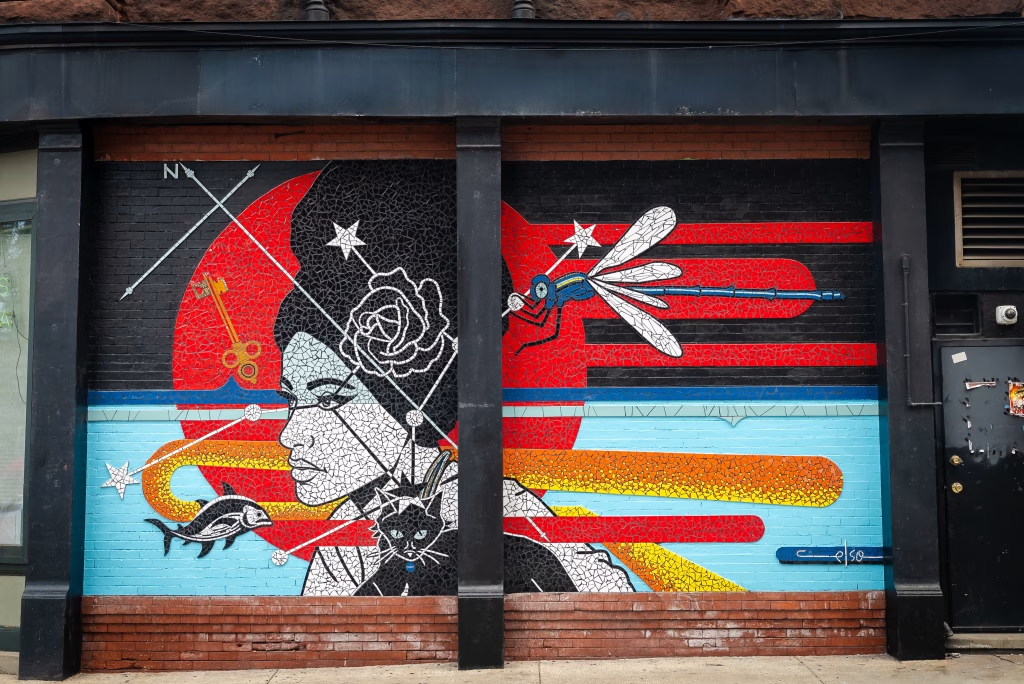
SOURCES OF STRENGTH: SYMBOLIC MOSAIC INSPIRED BY CELSO

Inspired by Celso, in partnership with Lynn Public Schools

Sources of Strength: Symbolic Mosaic

Colorful mural of a womans face with a rose in her hair, dragonfly, fish, and abstract celestial elements on a brick wall. Red, yellow, and blue shapes form the background.

GRADE LEVEL:

9-12

DURATION:

5-week sequence; class length varies by school schedule.

CONTENT & TOPICS:

Personal symbolism and sources of strength; mosaic design and construction; color planning and composition; safe use of mosaic tools; craftsmanship, persistence, and revision; public art and community connection.

STANDARD(S) ADDRESSED:

2019 Arts Framework 

Creating
VA:Cr1.1.HSI Generate and conceptualize artistic ideas and work.
VA:Cr2.1.HSI Organize and develop artistic ideas and work.
VA:Cr3.1.HSI Refine and complete artistic work.

Presenting
VA:Pr5.1.HSI Develop and refine artistic techniques and presentation.

Responding
VA:Re7.1.HSI Perceive and analyze artistic work.
VA:Re8.1.HSI Interpret intent and meaning in artistic work.

Connecting
VA:Cn10.1.HSI Synthesize personal experiences to make art.
VA:Cn11.1.HSI Relate artistic ideas to societal and cultural contexts.

ESSENTIAL QUESTION:

  • How can artists use symbols and materials to represent sources of strength?
  • How can mosaic techniques transform a personal idea into a lasting work of art?
  • How can individual symbols contribute to a stronger sense of community?

LEARNING (CONTENT) OBJECTIVES:

*Students will be able to: create a small mosaic inspired by a shape/symbol image significant to them.

*Students will be able to: learn how to use tools for making mosaic, create 3 mini thumbnail sketches to choose from to prep their designs. Students will then use knowledge of tools to create their own mosaic. Students will learn process of creating a mosaic from prep, planning, to adhering and finishing their mosaic.

LANGUAGE OBJECTIVES:

  • Students will discuss a personal source of strength using lesson vocabulary such as symbol, composition, tesserae, grout, and andamento.
  • Students will write a short artist statement explaining the meaning of their symbol and their color, material, and composition choices.
  • Students will listen and respond to peer feedback during the gallery walk using complete sentences and respectful critique language.

INSTRUCTIONAL ACTIVITIES:

Before lesson activity: Using the prompt provided to CTTS 2026, WHERE DOES YOUR POWER LIE IN CHALLENGING TIMES?

Students will think about an image/symbol that portrays the meaning of “finding strength in times of challenge.” Students will use brainstorming worksheet to help organize their ideas (see attachment will need to be added**) Students will learn about all of the tools used to create a mural as well as the process used to create the mural too.

  • Step 1: Quick Write (5 minutes) Prompt: Think of a time when life felt difficult. What helped you get through it?
  • Step 2: Strength Web→ Students create a web.

Center: ME

Branches:

  • People
  • Places
  • Activities
  • Objects
  • Values

Fill each section.

Step 3: Convert ideas to symbols
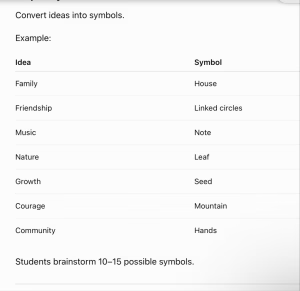
A chart lists ideas like family, friendship, music, nature, growth, courage, and community, each matched with a symbol such as house, linked circles, note, leaf, seed, mountain, and hands.

During lesson activity:

  • Week-by-Week Breakdown
  • Week 1
  • Brainstorm
  • Theme discussion
  • Strength web
  • Symbol exploration
  • Color planning
  • Goal
  • Complete sketches.
  • Week 2
  • Final Design Transfer
  • Trace design onto substrate
  • Select color palette
  • Practice cutting tile
  • Goal
  • Ready to begin construction.
  • Week 3
  • Mosaic Construction
  • Cut pieces
  • Begin adhering
  • Focus on craftsmanship
  • Goal
  • 50–75% complete.
  • Week 4
  • Mosaic Construction Continued
  • Complete placement
  • Review composition
  • Fix gaps
  • Goal
  • Finish tile placement.
  • Week 5
  • Grouting & Reflection
  • Learn grout process
  • Finish artwork
  • Artist statements
  • Reflection worksheet
  • After lesson activity:

See attachment https://docs.google.com/document/d/1b8CBdUQHqgy89xWqrXs2ieB4JNWiJLoQRsJl8jdb3gQ/edit?usp=sharing

  • Extension Activity

After completion, hold a gallery walk.

Students leave sticky notes answering:

  • “I notice…”
  • “I wonder…”
  • “I connect with…”

This creates a meaningful closing experience and helps students see how visual symbols communicate personal stories to others.

MATERIALS:

Before: Paper, pencil, colored pencils

Creative process: glass, Tile Nipper, sharpies, gloves, protective eyewear, surface to apply mural (board/wall/etc.)

Complete mural: apply adhesive to surface and apply tiles one by one in a uniform manner working from one side to the next.

  • 6″x6″ plywood squares
  • 8″x8″ plywood squares
  • Found objects
    • old trays
    • cutting boards
    • wooden panels
    • cabinet doors

Mosaic Materials

  • Ceramic tile
  • Recycled broken dishes
  • Colored glass tiles
  • Sea glass (optional)
  • Stone pieces (optional)

Tools

  • Tile nippers
  • Wheeled glass nippers
  • Safety goggles
  • Gloves
  • Pencils
  • Sharpies
  • Rulers

Adhesives

  • Weldbond
  • Mosaic adhesive

Finishing

  • Grout
  • Buckets
  • Sponges
  • Rags

VOCABULARY:

  • Mosaic – a design or a picture created with small pieces of material. (glass, pebbles, or tiles) placed on a base (floor, wall, or table)
  • Tessera (plural: Tesserae): One single piece of stone, glass, ceramic, or shell used to build a mosaic.
  • Grout: The soft paste pressed into the gaps between pieces to lock them in place.
  • Interstice: The empty gap or space left between individual tesserae.
  • Smalti: Thick, handmade opaque glass pieces often used in old Byzantine art.
  • Millefiori: Tiny handmade Italian glass pieces that show a multi-color flower pattern when cut.
  • Direct Method: Gluing pieces face-up straight onto the final base surface.
  • Indirect Method: Gluing pieces face-down on paper first, then flipping and pressing them into cement on the final surface.
  • Andamento: The visual flow, direction, and movement of the laid tesserae

Classical mosaic terms/vocabualry:

  • Opus Tessellatum: Simple rows of square or geometric pieces.
  • Opus Vermiculatum: Tiny pieces laid in curved lines to trace shapes and draw fine outlines.
  • Opus Sectile: Cut stone slabs shaped and fit together to make large distinct patterns. [1, 2]

ASSESSMENT METHODS:

Purpose

To evaluate students’ ability to develop a meaningful symbolic idea, plan and construct a mosaic safely, revise through the making process, and communicate how visual choices represent personal strength.

Formative Assessments

  • Quick Write & Strength Web: Students identify personal sources of strength and translate ideas into possible visual symbols.
  • Thumbnail / Color Planning Check: Students submit three mini sketches and identify a planned color palette before transferring the final design.
  • Tool & Safety Check: Students demonstrate safe use of tile nippers, protective eyewear, adhesives, and workspace procedures before independent construction.
  • Weekly Progress Conferences: Teacher checks andamento, spacing, craftsmanship, problem-solving, and progress toward each weekly goal.
  • Gallery Walk Feedback: Students use “I notice…,” “I wonder…,” and “I connect with…” prompts to respond to classmates’ symbolism and design choices.

Summative Assessments

  • Final Symbolic Mosaic: Completed mosaic that communicates a source of strength through an intentional symbol, color palette, composition, and mosaic technique.
  • Artist Statement / Reflection: Students explain the meaning of the chosen symbol, describe key material and design decisions, and identify a challenge they revised or solved.
  • Gallery Walk Participation: Students share the completed work and respond thoughtfully to peers’ interpretations and connections.

Reflection / Critical Response

  • What source of strength does your symbol represent, and why did you choose it?
  • How did color, andamento, or the placement of tesserae help communicate your idea?
  • What problem did you encounter during construction, and how did you revise your plan?
  • What did a classmate notice or connect with that helped you see your own work differently?

Rubric (4-Point Scale)

Criteria4 – Exceeds3 – Meets2 – Approaching1 – Beginning
Idea & SymbolismSymbol is highly personal, thoughtful, and clearly communicates a meaningful source of strength with strong visual originality.Symbol clearly communicates a source of strength and connects to the student’s intended meaning.Symbol has some connection to the theme, but meaning is general, unclear, or needs further development.Symbol or connection to the theme is missing or difficult to understand.
Planning, Color & CompositionThumbnails show strong experimentation; color and composition are carefully planned and create a clear focal point and visual flow.Three planning sketches are complete; color and composition choices support the final design.Planning is limited or incomplete; color or composition choices need refinement.Little or no planning is evident; composition is incomplete or unorganized.
Mosaic Technique & MaterialsTesserae are cut and placed skillfully; spacing, andamento, adhesive, and grout are controlled and enhance the design.Mosaic materials and tools are used correctly; spacing and placement are generally consistent.Technique is inconsistent; gaps, placement, cutting, adhesive, or grout need refinement.Minimal control of mosaic technique or materials; construction is incomplete or unsafe without repeated support.
Craftsmanship, Safety & RevisionWork is carefully constructed, refined, and complete; student consistently works safely, persists through challenges, and makes thoughtful revisions.Work is complete and mostly careful; student follows safety procedures and makes appropriate revisions.Craftsmanship or safety routines are inconsistent; project shows limited revision or persistence.Work is incomplete, rushed, or shows little evidence of safe practice, revision, or persistence.
Reflection & CommunicationArtist statement offers an insightful explanation of symbolism, visual choices, process, challenges, and personal/community connection using precise vocabulary.Artist statement clearly explains the symbol, major choices, and process using appropriate vocabulary.Reflection is brief or vague and only partly explains the meaning or process.Reflection is missing, incomplete, or unclear.

Student differentiation:

Tier 1 instructional supports/MTSS:

  • Teacher-created mosaic exemplar and step-by-step visual demonstration from sketch to grouting.
  • Planning templates for the strength web, symbol conversion, thumbnails, and color decisions.
  • Weekly checklist with a clear goal for each stage of the five-week process.
  • Teacher conferencing and opportunities to practice cutting and placement before working on the final substrate.

SEI strategies:

  • Real mosaic materials and illustrated vocabulary cards for tesserae, grout, interstice, andamento, direct method, and composition.
  • Sentence frames such as “My symbol represents ___ because ___” and “I used ___ to create visual movement.”
  • Option to brainstorm and label symbols in a home language before translating key ideas into English.
  • Partner rehearsal before the artist statement or gallery walk, with word banks and visual prompts.

SEL strategies:

  • Reflect on personal sources of strength and connect them to meaningful visual symbols.
  • Practice persistence through challenges and build confidence through completion of a long-term project.
  • Revise and adapt designs when materials or construction choices do not work as planned.
  • Use respectful gallery-walk responses to build connection and community.
    • IEP/504 accommodations (special populations), as applicable to the group of learners:
  • Extended time, shortened daily goals, and chunked directions with visual schedules.
  • Smaller substrate or reduced number of tesserae while preserving the same learning goals.
  • Pre-cut tile pieces, adaptive tools, or additional adult support for safe tool use when required.
  • Option to record the artist statement orally or use sentence starters / reduced writing expectations.
  • Preferential seating and repeated teacher check-ins during cutting, adhering, and grouting.

Alternative approach to project:

Collaborative Version: “Sources of Strength”

Each student receives a section.

Students create a symbol representing:

  • Hope
  • Family
  • Community
  • Nature
  • Creativity
  • Growth
  • Resilience

Teacher assembles sections into one larger mural.

Benefits:

  • Shared ownership
  • Smaller workload
  • Stronger community building

ARTIST BIOGRAPHY:

Celso González Quiñones is Puerto Rican mosaic artist who is recognized around the world for his amazing mixed-media murals and his community projects. Over the past several years, Celso completed a commission of the government of Puerto Rico, developing over 40 monumental public art projects throughout the island. Through his artwork, Celso celebrates where he came from, where he has gone and where he is going. All of Celso’s projects have significant community importance.

Instagram: @Celsoart

REFLECTION / FEEDBACK:

Please reflect on the lesson and give feedback when possible.

  • What would you change?
  • What worked well?

Extension Lesson:

Create a miniature version of a “place-making” sculpture that could have mosaic added around the outside of the piece.

(Celso’s elephant from wood[created with balsa wood]

Mini statue with structure within to hold shape then decorate exterior

with tiles.

REFERENCES:

Braziel, J. E. (2024). Caribbean and Latinx street art in Miami. Taylor & Francis.

Daichendt, G. J. (2010). Artist teacher. https://doi.org/10.2307/j.ctv36xw1vs

Daichendt, G. J. (2019). Editorial. Visual Inquiry, 8(2), 101-102.
     https://doi.org/10.1386/vi_8.2.101_2

(2026). Google Search. https://beyondwalls.org

Manco, T., Neelon, C., & Art, L. (2005). Graffiti Brasil.

Neelon, C. (2008). Caleb Neelon’s book of awesome.

Wiggins, G. P., & McTighe, J. (2005). Understanding by design. ASCD.

APPENDIX:

Skip to content