GRATITUDE MOVES A COMMUNITY INSPIRED BY MEGAN OLDHUES

Inspired by Megan Oldhues, in partnership with Lynn Public Schools

Gratitude Moves a Community

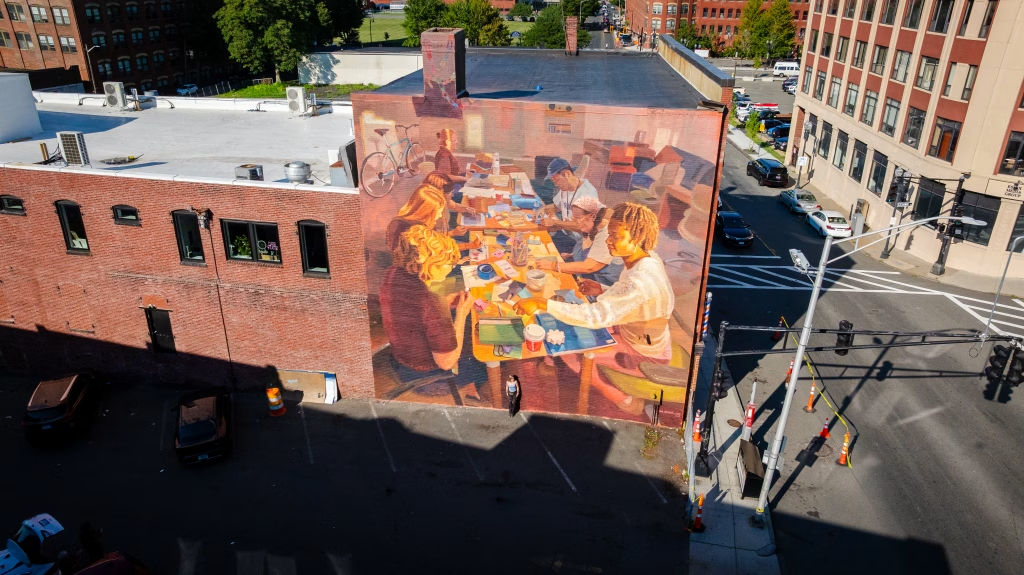
A mural on a brick building shows people sitting around a table with food and drinks, set in a city with roads, cars, and nearby buildings.

GRADE LEVEL:

Elementary.

DURATION:

Lessons will take place over 8 sessions.

CONTENT & TOPICS:

  • Generosity
  • Megan Oldhues
  • Found object art/ 3D sculpture
  • Motion and Stability
  • upcycling

STANDARD(S) ADDRESSED:

Visual Arts Standards

  • (5-6 V. Cr.01) Generate and conceptualize artistic ideas and work. Generate artworks that integrate ideas with new materials, methods, and approaches
  • (3-4.V.Cr.02)Organize and develop artistic ideas and work. Use a teacher selected strategy (e.g., sketches, prototypes, rough drafts) to organize artistic ideas.
  • (3-4.V.Cr.03)  Refine and complete artistic work. Respond to an artistic challenge and draft possible resolutions.
  • (3-4.V. P. 06)   Convey meaning through the presentation of artistic work. Share a work that expresses, evokes, or communicates a selected idea (e.g., students are asked to create a sculpture that expresses two opposing emotions, such as happiness and sadness).

Social Emotion Standards

  • Social Emotional Learning: Social Awareness:  Demonstrating empathy and compassion.
  • Social Emotional Learning: Social Awareness: Understanding and expressing gratitude.
  • Social Emotional Learning: Relationship Skills: Developing positive relationships.
  • Social Emotional Learning: Responsible Decision-Making Reflecting on one’s role to promote personal, family, and community well-being
  • Social Emotional Learning: Responsible Decision – Evaluating personal, interpersonal, community, and institutional impacts

STEAM Standards

  • ESS3. Earth and Human Activity
    • 5-ESS3-1 Obtain and combine information about ways communities reduce human impact on the Earth’s resources and environment by changing community practice or process.
  • PS2. Motion and Stability: Forces and Interactions.
    • 3-PS2-4 Define a simple design problem that can be solved by using interactions between magnets.
    • 3-PS2-1 Provide evidence to explain the effect of multiple forces, including friction, on an object.
  • ETS1 Engineering Design
    • 4.3-5-ETS1-5(MA) Evaluate relevant design features that model of a at must be considered in building a model or prototype of a solution to a given design problem.

ESSENTIAL QUESTION:

Primary: How does gratitude move a community closer together?

Supporting: How does a gift create a chain of positivity and gratitude within a community?

How do artists and scientists create change?

How does public art strengthen the community?

LEARNING (CONTENT) OBJECTIVES:

  • Students will be able to reflect on the concept of gratitude and provide an example in their community
  • Students will be able to create an art piece using found objects that has an element of movement
  • Students will be able to identify actions that would positively impact change in a classroom, school, and/or community.
  • Students will be able to identify others’ need for empathy and respond in respectful ways

LANGUAGE OBJECTIVES:

  • Students will be able to explain the concept of gratitude using examples from their life or observations of the world around them.
  • Students will be able to write a positive affirmation and incorporate it into their art piece or artist statement.
  • Students will be able to listen and relate to examples of gratitude presented by peers.

INSTRUCTIONAL ACTIVITIES:

Lesson 1 and 2

Before lesson activity:

  • Present Megan’s work and discuss the mural and  the artist’s creative process using the Beyond Wall’s website.
  • Discuss gratitude and its meaning, displaying thoughts and a working definition on paper to be displayed throughout the unit
  • Discuss how gratitude can help others and promote positivity and community.

Activity:

  • Using various card-making materials and embellishments such as glitter, stickers, or washi tape, students will make a card with a positive statement to exchange with a random peer.
  • Music is played similar to “musical chairs” and students begin to pass their cards to each other. It is important that they do not stop to read each other’s cards, but rather glance and continue passing until the music stops.

Lesson 3-6

  • Scatter upcycled objects in the middle of a table. Display your model of the gift. Students sit around the table and have a discussion about what they notice and wonder about your piece. For example:
    • How are the pieces connected?
    • Are the colors significant?
  • Teacher then presents a video about movement in visual arts: https://app.theartofeducation.edu/flex/videos/what-is-movement?query=movement&sortBy=relevance
  • Teacher then presents the project:
    • Ask students to create a 3D gift using found objects or upcycled materials.
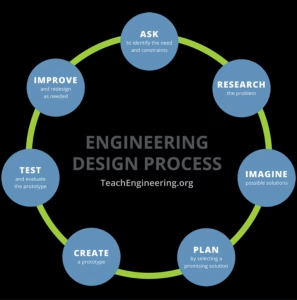
  • Students use a graphic organizer to plan out their piece first.Over the next few classes students will work through their creative process, revising and problem solving as they go.Circular diagram of the engineering design process with seven steps: Ask, Research, Imagine, Plan, Create, Test, and Improve; arrows connect each step in order.

Elevating the STEAM component by layering in the concept of “movement”. Students’ work should incorporate a moving element . Each session devotes a 5 minute wrap up at the end where in small groups students share out where they are in the design process.

After Activity:

  • Students will draft an artist’s statement to accompany their gift.

MATERIALS:

  • Upcycled objects collected by students and teachers.
    • For example: water bottles, empty tape rolls or glue sticks, school lunch utensils or milk cartons

For more examples click link: Upcycle Supply List Ideas

VOCABULARY:

balance

movement

gratitude

community

3D

Upcycle

diagram

labels

revise

ASSESSMENT METHODS:

Purpose

To evaluate students’ understanding of gratitude and community, their ability to plan and construct a 3D upcycled sculpture with an element of movement, their persistence and revision during the design process, and their ability to communicate meaning through an artist statement.

Formative Assessments

  • Gratitude Discussion & Card Exchange: Student responses and positive statements demonstrate understanding of gratitude, empathy, and the ways small actions can affect a community.
  • Planning Graphic Organizer: Students diagram the proposed sculpture, label materials and connections, and identify where movement will occur before building.
  • Teacher Observation & Conferences: During construction, the teacher checks purposeful use of upcycled materials, safe assembly, problem-solving, movement, revision, and persistence.
  • Five-Minute Progress Shares: At the end of each work session, students explain where they are in the design process, identify a challenge, and describe a next step.
  • Critical Response Organizer: Students use the sculpture graphic organizer and peer discussion prompts to notice, question, and respond to developing work.

Summative Assessments

  • Final 3D Upcycled Gift Sculpture: Completed sculpture uses found or upcycled materials, communicates an idea connected to gratitude or community, and includes an intentional moving element.
  • Artist Statement: Students explain the meaning of the gift, the role of the chosen materials and movement, and one problem they solved or revision they made.
  • Sharing / Reflection: Students present or discuss their finished piece and connect their artistic choices to gratitude, generosity, empathy, or positive community impact.

Reflection Prompts

  • Who or what inspired the idea behind your gift sculpture?
  • How do the materials you chose connect to the idea of upcycling or caring for the community?
  • How does the moving element change the way viewers experience your sculpture?
  • What challenge did you face while building, and how did you revise or solve the problem?
  • What positive message or affirmation do you want your artwork to share?

Rubric (4-Point Scale)

Criteria 4 – Exceeds 3 – Meets 2 – Approaching 1 – Beginning
Gratitude & Community Meaning Artwork communicates a thoughtful, specific idea about gratitude, generosity, empathy, or community and creates a strong emotional connection. Artwork clearly communicates an idea connected to gratitude or community. Connection to gratitude or community is present but general, inconsistent, or needs explanation. Connection to gratitude or community is unclear or missing.
Use of Upcycled Materials Found materials are selected and transformed in highly inventive, purposeful ways that strengthen the meaning of the sculpture. Upcycled materials are used effectively and support the overall idea. Some upcycled materials are used, but choices are limited, decorative, or only partly connected to the idea. Minimal evidence of purposeful use of found or upcycled materials.
Movement & STEAM Design Moving element is reliable, inventive, and clearly integrated into the structure; student demonstrates strong problem-solving with forces, balance, or connections. Sculpture includes a functional moving element that is intentionally planned and securely constructed. Movement is attempted but inconsistent, fragile, or only partly integrated into the design. Moving element is missing or does not function.
Craftsmanship, Persistence & Revision Construction is careful, stable, and refined; student persists through challenges, tests ideas, and makes thoughtful revisions independently. Construction is complete and mostly careful; student revises and solves problems with appropriate support. Craftsmanship or stability is inconsistent; student shows limited revision or persistence. Work is incomplete, rushed, unstable, or shows little evidence of revision or problem-solving.
Artist Statement & Communication Artist statement insightfully explains gratitude/community meaning, materials, movement, process, and revisions using clear and specific vocabulary. Artist statement clearly explains the idea, materials, movement, and one aspect of the process. Statement is brief or vague and only partly explains meaning or process. Statement is missing, incomplete, or unclear.

Student differentiation:

  • Tier 1 instructional supports/MTSS:
    • Teacher model
  • SEI strategies:
    • Movement video clip
    • Find a simple definition: Look up gratitude in the dictionary definition, then translate it into clear, everyday language you easily understand.
    • Teacher model and students’ in process work is a visual for vocabulary review / understanding.
  • SEL strategies:
    • Practice persistence and build frustration tolerance skills through challenges
    • Learn to revise and adapt designs
    • Build condense through completion of a long-term project.
  • IEP/504 accommodations (special populations), as applicable to the group of learners:
  • Extended time, shorter work goals, and chunked directions with visual sequencing.
  • Adaptive scissors, fastening tools, adhesives, or pre-prepared materials when needed for safe participation.
  • Smaller or simplified sculpture format while preserving the requirements for upcycling, meaning, and movement.
  • Option to dictate or orally record the artist statement, use sentence starters, or reduce written output as appropriate.
  • Frequent teacher check-ins, preferential seating, movement breaks, and peer support as required.

ARTIST BIOGRAPHY:

B. 1997 Toronto, Canada: Megan Oldhues is a Toronto-based muralist and painter working at the intersection of classical realism and contemporary public art. Known for her large-scale impressionistic murals, Megan captures everyday life with a focus on intimacy, emotional resonance, and human connection. She began large-scale painting in 2015, learning to work quickly and instinctively while producing unsanctioned murals in Toronto. Her early experience led to mentorship opportunities with some of the city’s top street artists and scenic painting work on major film and TV productions including The Boys, Chucky, and Jack Reacher. These fast-paced environments sharpened her technical skill and affirmed her drive to pursue public-facing, emotionally rich work. Megan is the founder of a mural production company and has completed projects for clients such as Puma, Foot Locker, Reese’s, and the City of Toronto. Her practice involves building relationships with local communities, photographing real people and spaces, and transforming these moments into figurative, painterly compositions. Using only primary colors and a limited acrylic palette, she hand-mixes each hue to achieve a distinctive softness and depth, similar to oil painting.In July 2025, Megan led production on Hangar Jam, Toronto’s first street art weekend inside Toronto’s historic YZD Hangar 5, which brought together 10 artists and over 1,000 attendees. Her goal is to push what’s possible in muralism, especially as one of the few women in North America working at this scale and painterly style.Megan’s murals have appeared across Canada, the U.S., Europe, and South America, and continue to evolve as narrative landmarks that elevate the poetry of everyday life

REFLECTION/FEEDBACK:

Please reflect on the lesson and give feedback when possible.

  • What would you change?
  • What worked well?
  • Extension Ideas: Community Mural about gift giving : The giving tree

REFERENCES:

Braziel, J. E. (2024). Caribbean and Latinx street art in Miami. Taylor & Francis.

Daichendt, G. J. (2010). Artist teacher. https://doi.org/10.2307/j.ctv36xw1vs

Daichendt, G. J. (2019). Editorial. Visual Inquiry, 8(2), 101-102.

https://doi.org/10.1386/vi_8.2.101_2

(2026). Google Search. https://beyondwalls.org

Manco, T., Neelon, C., & Art, L. (2005). Graffiti Brasil.

Neelon, C. (2008). Caleb Neelon’s book of awesome.

Wiggins, G. P., & McTighe, J. (2005). Understanding by design. ASCD.

APPENDIX:

Skip to content