
Elementary.
Lessons will take place over 8 sessions.
Visual Arts Standards
Social Emotion Standards
STEAM Standards
Primary: How does gratitude move a community closer together?
Supporting: How does a gift create a chain of positivity and gratitude within a community?
How do artists and scientists create change?
How does public art strengthen the community?
Lesson 1 and 2
Before lesson activity:
Activity:
Lesson 3-6
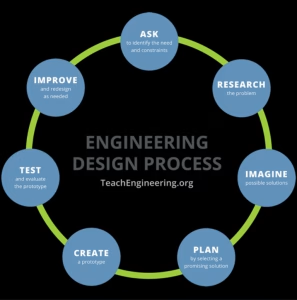
Elevating the STEAM component by layering in the concept of “movement”. Students’ work should incorporate a moving element . Each session devotes a 5 minute wrap up at the end where in small groups students share out where they are in the design process.
After Activity:
For more examples click link: Upcycle Supply List Ideas
balance
movement
gratitude
community
3D
Upcycle
diagram
labels
revise
To evaluate students’ understanding of gratitude and community, their ability to plan and construct a 3D upcycled sculpture with an element of movement, their persistence and revision during the design process, and their ability to communicate meaning through an artist statement.
| Criteria | 4 – Exceeds | 3 – Meets | 2 – Approaching | 1 – Beginning |
| Gratitude & Community Meaning | Artwork communicates a thoughtful, specific idea about gratitude, generosity, empathy, or community and creates a strong emotional connection. | Artwork clearly communicates an idea connected to gratitude or community. | Connection to gratitude or community is present but general, inconsistent, or needs explanation. | Connection to gratitude or community is unclear or missing. |
| Use of Upcycled Materials | Found materials are selected and transformed in highly inventive, purposeful ways that strengthen the meaning of the sculpture. | Upcycled materials are used effectively and support the overall idea. | Some upcycled materials are used, but choices are limited, decorative, or only partly connected to the idea. | Minimal evidence of purposeful use of found or upcycled materials. |
| Movement & STEAM Design | Moving element is reliable, inventive, and clearly integrated into the structure; student demonstrates strong problem-solving with forces, balance, or connections. | Sculpture includes a functional moving element that is intentionally planned and securely constructed. | Movement is attempted but inconsistent, fragile, or only partly integrated into the design. | Moving element is missing or does not function. |
| Craftsmanship, Persistence & Revision | Construction is careful, stable, and refined; student persists through challenges, tests ideas, and makes thoughtful revisions independently. | Construction is complete and mostly careful; student revises and solves problems with appropriate support. | Craftsmanship or stability is inconsistent; student shows limited revision or persistence. | Work is incomplete, rushed, unstable, or shows little evidence of revision or problem-solving. |
| Artist Statement & Communication | Artist statement insightfully explains gratitude/community meaning, materials, movement, process, and revisions using clear and specific vocabulary. | Artist statement clearly explains the idea, materials, movement, and one aspect of the process. | Statement is brief or vague and only partly explains meaning or process. | Statement is missing, incomplete, or unclear. |
Student differentiation:
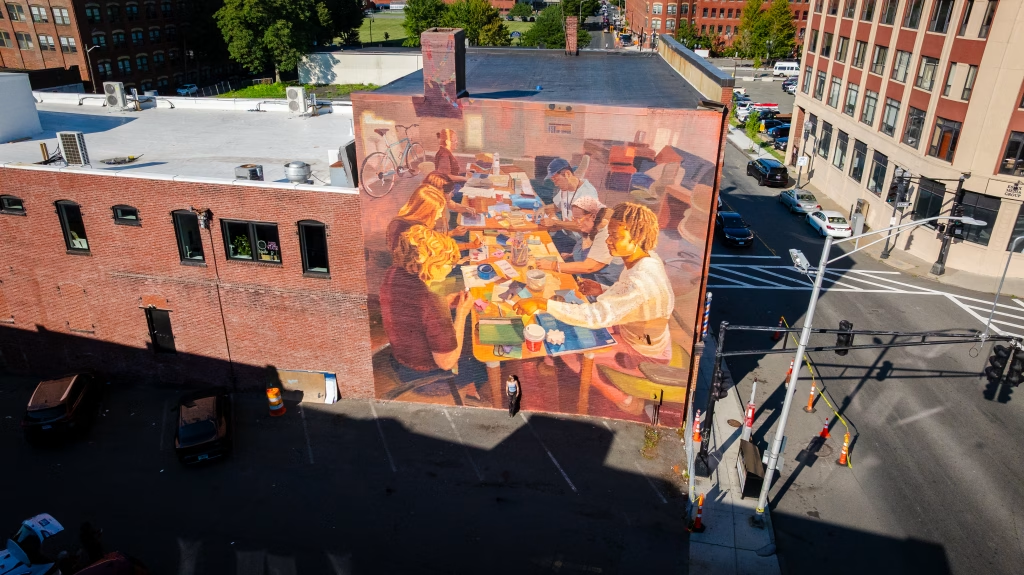
B. 1997 Toronto, Canada: Megan Oldhues is a Toronto-based muralist and painter working at the intersection of classical realism and contemporary public art. Known for her large-scale impressionistic murals, Megan captures everyday life with a focus on intimacy, emotional resonance, and human connection. She began large-scale painting in 2015, learning to work quickly and instinctively while producing unsanctioned murals in Toronto. Her early experience led to mentorship opportunities with some of the city’s top street artists and scenic painting work on major film and TV productions including The Boys, Chucky, and Jack Reacher. These fast-paced environments sharpened her technical skill and affirmed her drive to pursue public-facing, emotionally rich work. Megan is the founder of a mural production company and has completed projects for clients such as Puma, Foot Locker, Reese’s, and the City of Toronto. Her practice involves building relationships with local communities, photographing real people and spaces, and transforming these moments into figurative, painterly compositions. Using only primary colors and a limited acrylic palette, she hand-mixes each hue to achieve a distinctive softness and depth, similar to oil painting.In July 2025, Megan led production on Hangar Jam, Toronto’s first street art weekend inside Toronto’s historic YZD Hangar 5, which brought together 10 artists and over 1,000 attendees. Her goal is to push what’s possible in muralism, especially as one of the few women in North America working at this scale and painterly style.Megan’s murals have appeared across Canada, the U.S., Europe, and South America, and continue to evolve as narrative landmarks that elevate the poetry of everyday life
Please reflect on the lesson and give feedback when possible.
Braziel, J. E. (2024). Caribbean and Latinx street art in Miami. Taylor & Francis.
Daichendt, G. J. (2010). Artist teacher. https://doi.org/10.2307/j.ctv36xw1vs
Daichendt, G. J. (2019). Editorial. Visual Inquiry, 8(2), 101-102.
https://doi.org/10.1386/vi_8.2.101_2
(2026). Google Search. https://beyondwalls.org
Manco, T., Neelon, C., & Art, L. (2005). Graffiti Brasil.
Neelon, C. (2008). Caleb Neelon’s book of awesome.
Wiggins, G. P., & McTighe, J. (2005). Understanding by design. ASCD.