TAYLOR WHITE COMPREHENSIVE LESSON PLAN: CLASSROOM TO THE STREETS (ELEMENTARY EDITION)

Inspired by Taylor White, In Partnership with St. Mary's School

The Friendly Wall: Splashes of Joy and Moving Lines (A Taylor White Inspired Study)

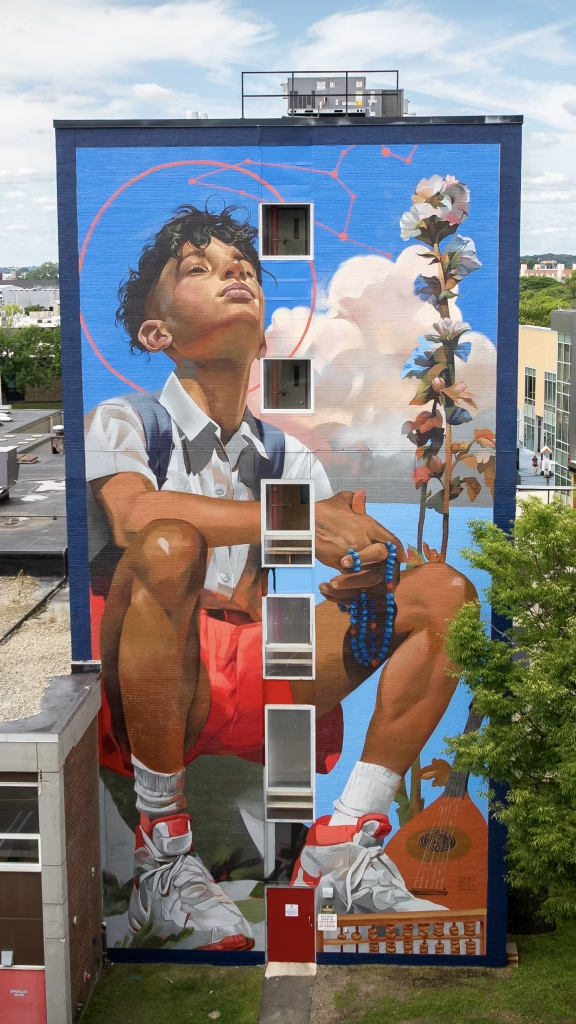
A mural on a building shows a boy in red shorts crouching, holding blue beads, with a flower and guitar beside him. He looks upward, eyes closed, against a vibrant blue sky and clouds.

1. Lesson Administrative Overview

  • Lesson Plan Title: The Friendly Wall: Splashes of Joy and Moving Lines (A Taylor White Inspired Study)
  • Grade Level: 3rd–5th Grade (Elementary Art)
  • Duration: Five 45-minute class sessions
  • Rationale: This unit introduces elementary students to the exciting world of neighborhood street art. Young learners transition from small paper drawings to understanding large-scale public art using step-by-step methods. The lessons celebrate local community, music, and inspiring young leaders like Blessed Carlo Acutis. This project builds hand-eye coordination, group cooperation, and an understanding of physical materials.

2. Content, Topics, and Standards Alignment

  • Public Art & Sharing Spaces: What street art is, how it brightens up a neighborhood, and why artists must care for their shared environment.
  • The Taylor White Inspired Style: Capturing dynamic, zooming action lines and mixing realistic faces with colorful shapes.
  • A Saint for Kids: Finding inspiration in the life of Carlo Acutis—a regular boy who loved video games, computers, and casual clothes (like jeans, hoodies, and sneakers) to show that anyone can spread kindness.
  • The Rhythm of Music: Translating favorite sounds, beats, and instruments into flowing, abstract background waves.
  • The Engineering of Scale: Introduction to how simple grids, measurement, and light projection expand miniature drawings onto big surfaces.
  • The Science of Paint: Exploring how liquid paint dries into a solid plastic shield, and why exterior walls require deep cleaning.

Standards Addressed

Framework Standard Identifier Description
MA Visual Arts (2019) Creating (1.2.a) Demonstrate increasing skill and use of various media, materials, and art-making techniques.
MA Visual Arts (2019) Responding (7.1.a) Identify and describe visual elements in an artwork and discuss what they make the viewer feel.
MA Visual Arts (2019) Connecting (11.1.a) Identify how art reflects the history and values of a community.
STE (2016) 3-5-ETS1-2 Generate and compare multiple possible solutions to a problem based on how well each meets criteria.
STE (2016) 5-PS1-1 Develop a model to describe that matter is made of particles too small to be seen (Applied to drying paint layers).


The “So What?” Factor

This unit proves that elementary art is directly connected to science, math, and engineering. By building on standards 3-5-ETS1-2 and 5-PS1-1, students learn that art involves problem-solving. They measure shapes to figure out how small sketches fit perfectly on giant walls.

They also look at the science of molecules. Students discover that liquid acrylic paint is full of microscopic plastic particles floating in water. When the water evaporates, those invisible particles lock arms to create a permanent, colorful shield that protects the wall against wind and rain.

3. Essential Questions and Learning Objectives:

Essential Questions

  1. How can we use moving lines, bright colors, and music to bring joy to our neighborhood?
  2. How does the image of Carlo Acutis in a regular hoodie and sneakers show us that everyday kids can do extraordinary things?
  3. How does liquid paint change into a solid, waterproof shield when it dries?

Learning Objectives (SWBAT)

  • Create an action-packed portrait painting using Taylor White’s style of sweeping gestural lines, floating shapes, and musical rhythms.
  • Draw an inspiring young person using relatable clothing choices (like a polo shirt, jeans, and sneakers) so that any neighborhood child can identify with the artwork.
  • Use a simplified grid mapping system or a digital light projector to accurately enlarge a small sketch onto a giant poster board.
  • Explain how liquid paint changes into a permanent solid film through water evaporation.

Language Objectives (SWRL)

  • Speaking: Students will describe their artworks during peer-to-peer sharing using the terms movement, rhythm, evaporation, and iconography.
  • Writing: Students will complete a short, three-sentence artist statement describing the “superpower of kindness” behind their mural design.
  • Reading: Students will read a simplified, illustrated biography of Carlo Acutis and look at photos of Taylor White’s public murals.
  • Listening: Students will listen quietly to a musical track and track the auditory rhythm by moving their paintbrushes in the air.

4. Instructional Sequence: Before, During, and After

Before Lesson Activity (Anticipatory Set)

  • The Neighborhood Logo: Show the official Beyond Walls / Classroom to the Streets logo to help students feel like real, professional community artists.
  • Entry Ticket Challenge: Ask students: “If our school wall was a giant television screen, what happy message or favorite song should it broadcast to the whole neighborhood today?“

During Lesson Activity (Core Instruction)

  • Phase 1: Taylor White Style & Music Action: The teacher plays a lively musical track. The teacher models how to draw quick, swooping, “non-static” charcoal lines on paper that follow the beat of the music. Students practice drawing continuous, sweeping curves that show speed and joy.
  • Phase 2: Designing a Relatable Icon: The class looks at old, historic paintings of kings and historical figures in fancy robes. The teacher models how to switch this point of view to make a modern portrait: sketching a friendly teenager in a t-shirt, casual jeans, and running sneakers. Students practice drawing a person that looks exactly like a friend they would play with at recess.
  • Phase 3: The Magic Projector & Grid Engineering: The teacher sets up a digital projector. Students observe how moving the projector backward makes the image larger, and moving it forward makes it smaller. The teacher introduces standard 3-5-ETS1-2 by showing how to fix a blurry image by turning the focus lens. Students tape up their large boards and trace the basic shapes.
  • Phase 4: The Polymer Science Lab: Before painting, the teacher drops acrylic paint onto a plastic sheet to illustrate standard 5-PS1-1. Students touch a dry patch of acrylic paint and a wet patch of acrylic paint to compare them. The teacher explains how water evaporation allows the invisible plastic resin particles to lock together.
  • Phase 5: Studio Fabrication: Students work in small teams to fill in their traced mural outlines with bright, high-contrast acrylic colors.

After Lesson Activity (Cool Down)

  • The High-Five Gallery Walk: Students place their finished murals around the room. They walk around with sticky notes and give a “high-five note” to a classmate, writing down one spot where they see great musical movement and one spot where the character looks friendly and real.

5. Instructional Materials and Vocabulary Development

Materials

  • Technology: Classroom iPad for sketching; digital short-throw projector.
  • Art Supplies: Primed cardboard panels or large butcher paper; student-grade heavy-body acrylic paints; wide foam brushes; soft drawing charcoal.
  • Science Tools: Spray bottles with water; paper towels; liquid soap; small plastic cups for mixing binders.
  • Planning Tools: “My Mural Blueprint” worksheet (with 4×4 coordinate grids).

Vocabulary Deep-Dive (7 Steps Strategy)

[Movement]    ──> Lines and shapes that make an artwork look like it is zooming or dancing.

*Move your whole arm in a big wave to show movement before painting.*

[Rhythm]      ──> A visual repeating pattern that feels like a steady musical beat.

*Paint dots and stripes to match the tap-tap-tap of a drum.*

[Iconography] ──> The special clothes, tools, and symbols used to tell a story about a person.

*Draw high-top sneakers to show our saint is a modern kid on the go.*

[Evaporation] ──> When liquid water disappears into the air and leaves dry things behind.

*Watch a wet spot on the chalkboard vanish to understand paint drying.*

6. Comprehensive Material Science Breakdown

To work safely and successfully, our young artists learn how materials work on an outdoor wall.

       HOW PREPARATION WORKS                       HOW PAINT DRIES

┌──────────────────────────────┐          ┌──────────────────────────────┐

│   CLEAN WALL WITH SOAP       │          │     WET PAINT APPICATON      │

│ Cleans away dirt and dust so │          │ Plastic particles and color  │

│ the paint stays stuck.       │          │ float together in water.     │

└──────────────┬───────────────┘          └──────────────┬───────────────┘

▼                                         ▼

┌──────────────────────────────┐          ┌──────────────────────────────┐

│   THE BASE COAT (PRIMER)     │          │      WATER EVAPORATION       │

│ A thick background paint that│          │ The water dries up into the  │

│ stops the wall from soaking. │          │ air and disappears.          │

└──────────────────────────────┘          └──────────────┬───────────────┘

▼

┌──────────────────────────────┐

│    SOLID PLASTIC SHIELD      │

│ Tiny plastic pieces lock     │

│ arms into a waterproof wall. │

└──────────────────────────────┘

The Simple Science of Wall Prep

  1. Cleaning the Surface: Outdoor walls are covered in invisible dust, outdoor pollen, and grease. If we paint right over dirt, the paint will peel right off. Washing the surface with soap breaks up oils so the clean wall can hold onto the paint.
  2. The Base Coat Shield: Bricks and wood have tiny invisible holes that soak up moisture like a sponge. We apply a uniform layer of white primer paint to seal those holes up tightly. This keeps moisture from sneaking up behind our beautiful painting and bubbling the colors.

The Simple Science of Acrylic Paints

  1. The Paint Team: Acrylic paint is made of three magical ingredients: Pigment (the crushed-up colorful powder), Binder (the liquid plastic glue), and Water (the vehicle that lets us spread the paint with a brush).
  2. Drying and Locking Arms: When paint is wet, the tiny plastic binder pieces float around happily. But as the water dries up into the air through evaporation, those tiny pieces are forced together. They lock onto each other tightly, trapping the colorful pigment inside a permanent, bendable plastic shield that rain cannot wash away.

7. Assessment Methods and Critical Response

Formative Checks

  • The Projector Focus Check: The teacher checks each group to ensure they understand how to focus the lens and match their paper guidelines.
  • The Touch Test: Students check their backgrounds to make sure the paint is dry before painting new details over it.

Summative Assessment Rubric

Criteria 3 Stars: Awesome! 2 Stars: Getting There 1 Star: Needs Work
Action & Lines Lines are swooping, bold, and look like they are dancing with musical rhythm. Lines are mostly smooth, but look a little stiff or frozen. Lines are shaky, small, or do not show action.
Friendly Iconography The character is easy to recognize and wears everyday sneakers and hoodies that look like us. The character wears everyday clothes, but looks a bit like a cartoon profile. The clothing is confusing or does not look like a modern person.
Grid Engineering Traced image matches the design perfectly without stretching or looking squished. Traced image is slightly crooked or shifted on the board. The image is completely distorted or blurry.
Teamwork & Clean Up Shared all paints nicely, listened to group ideas, and washed brushes completely. Shared materials but forgot to clean the brush tips. Had trouble sharing or left a messy workspace.

Critical Response: See / Think / Wonder

Students look at a classmate’s finished board and answer these questions out loud:

  1. See: What everyday clothing items or musical shapes do you recognize right away?
  2. Think: Why does painting this character in sneakers make them feel like a real friend who belongs in our neighborhood?
  3. Wonder: If this mural was painted on a giant wall downtown, what would drivers think when they saw it?

8. Differentiation and Inclusive Support (MTSS / SEI / SEL)

  • Tier 1 Supports (MTSS): Group roles are assigned intentionally (e.g., pairing a student who is excellent at measuring with a student who loves expressive brush painting).
  • SEI Strategies (Language Learners): Use visual matching cards showing pictures of Evaporation (water puddle disappearing) and Rhythm (a drumbeat waveform). Use simple sentence frames: “This mural has rhythm because I see repeating [dots/waves].”
  • SEL Connections: Use Carlo Acutis’ story to discuss how regular, everyday hobbies (like gaming or drawing) can be used to make the world a kinder, happier place.
  • IEP / 504 Accommodations: Provide extra-thick foam comfort grips for paintbrushes; provide pre-outlined, large-scale coloring templates for students with fine-motor tracking challenges.

9. Artist Profile: Taylor White and Scholarly Context

Artist Biography

Taylor White is an amazing artist who travels the entire world to paint giant murals on the sides of buildings. She loves action, running, and dance! Instead of painting stiff, frozen portraits, she uses sweeping gestures that make her characters look like they are caught mid-jump or flying through the air. As an official mentor for the Beyond Walls school cohort, Taylor teaches kids that walls do not have to be boring grey concrete—they can become bright windows of kinetic action, storytelling, and joyful play.

  • Official Website Portfolio: taylorwhite.art

References

  • Daichendt, G. J. (2010). Artist teacher. Intellect Books.
  • Wiggins, G. P., & McTighe, J. (2005). Understanding by design. ASCD.
  • Golden, M. (2014). Acrylic polymers and paint drying mechanics. Just Paint Education Guide.

10. Appendix: Student Worksheet

My Mural Blueprint Page

Directions: Use this 4-box map to check your grid work before using the big projector!

   [ Box A: The Face & Halo ]       [ Box B: The Music Waves ]

Draw friendly facial expressions   Draw lines that match the song’s beat


[ Box C: Hoodie & Polo Shirt ]    [ Box D: The Action Sneakers ]

Draw everyday, relatable clothes   Draw cool shoes ready to run and play

Skip to content