“Show Me What You See” Technique Inspired by SPEKER
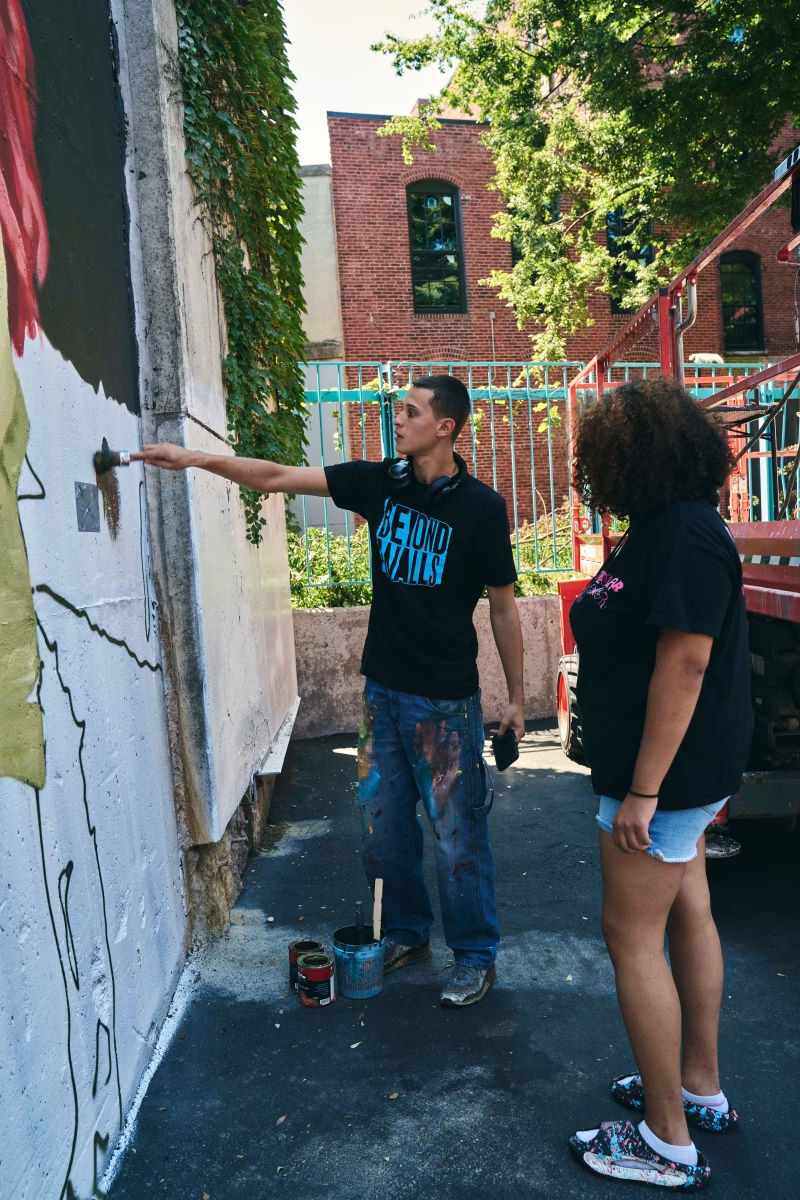
Create an individual artwork, and bring that artwork together to make a shared artwork.
Jump to section
Key Indicators
Create – Conceiving and developing new artistic ideas and work.
Respond – Understanding and evaluating how the arts convey meaning.
Present – Interpreting and sharing artistic work.
Connect – Relating artistic ideas and work with personal meaning and external context.
Learning Objectives
Students will be able to…
- Create an individual artwork, and bring that artwork together to make a shared artwork.
- Explore the work of artists who tell stories through imagery by looking, talking and drawing.
- Use the “Show Me What You See” technique to help me look closely at artwork.
- Work with my peers to make a shared mural with drawing, collage, and paint.
- Present my work as part of a larger artwork, and I can share my response to my own work and also to the work of my peers.
Standards
- 5–6.V.Cr.01 – Generate and conceptualize artistic ideas and work. Students expand on personal artistic ideas and connect them to social, cultural, and historical context.
- 5–6.V.Cr.02 – Organize and develop artistic ideas and work. Students create sketches, plans, and models to explore multiple approaches to a theme.
- 5–6.V.Cr.03 – Refine and complete artistic work. Students use feedback and self-reflection to revise and improve artwork.
- 5–6.V.P.06 – Convey meaning through the presentation of artistic work. Students collaborate to plan, prepare, and present artworks in ways that communicate a collective theme.
- 5–6.V.R.07 – Perceive and analyze artistic work. Students analyze how line, implied movement, and composition contribute to meaning.
- 5–6.V.Co.10 – Synthesize and relate knowledge and personal experiences to make art. Students draw from their own stories to contribute to a collaborative mural.
- 5–6.V.Co.11 – Relate artistic ideas and works to societal, cultural, and historical contexts. Students compare the role of murals and street art in different communities.
Content & Topics
Mural, Street art, Speker, Mr. B Baby, Line, Implied line, Storytelling, Drawing, Collage, Painting
Materials
- Large paper roll
- Pencils
- Sharpies
- Scissors
- Collage paper
- Glue
- Paint
Vocabulary
- Mural
- Street art
- Collage
- Line
- Implied line
- Storytelling
Procedures
The project aims to produce one large picture, made up of collaged paper characters with more than 100 children, ensuring the contribution of each child/participant is included. Before beginning with students, choose a theme for the mural.
Day 1
Anticipatory Set:
- Look – Explore and discuss artwork with focus on storytelling and implied movement
- Learn – Visual storytelling, Line/Implied Line, Collage
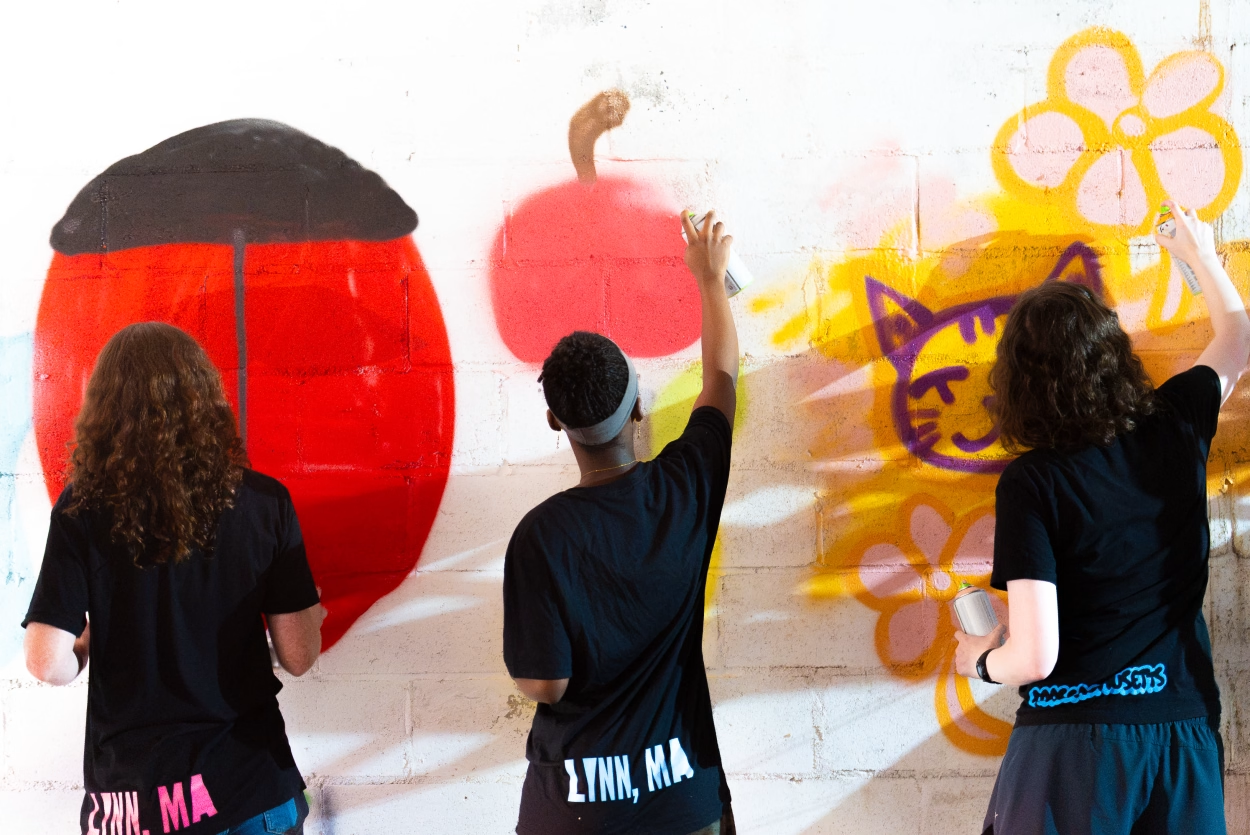
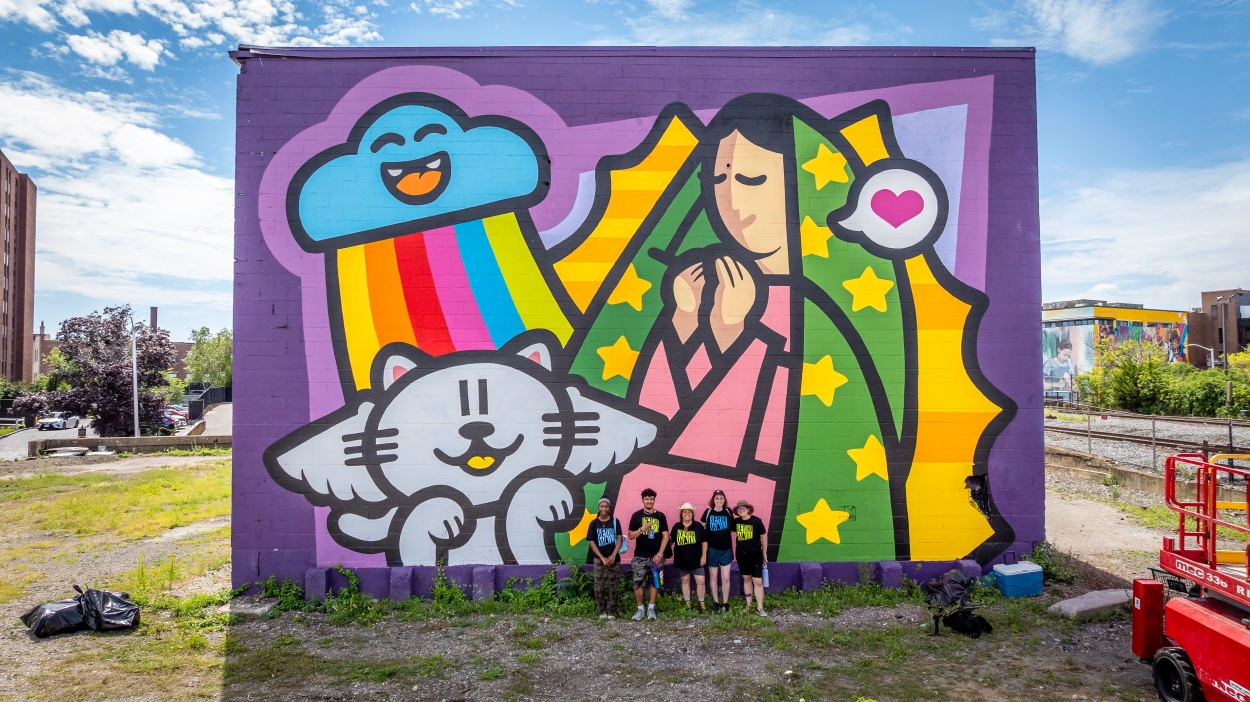
- Do – Show Me What You See – Find and draw characters in Mr B Baby’s Beyond Walls mural
Day 2
- Paint muted background colors on large plywood/board/canvas to
create background. - Each student draws and colors characters on paper then cuts them out.
- Students experiment with composition by moving around, overlapping,
fitting together their characters on the large plywood/board/canvas
“world”.
Day 3
- Painting demonstration – how to mix and apply paint
- Students paint newspaper/recyclable paper sheets for collaged
characters on Day 4.
Day 4
- Collage demonstration how to cut shapes, move shapes to create
different pictures (figurative art), faces, encouraging play before gluing. - Each student creates a collage character, object, or natural element
using painted papers. - Students experiment with composition by moving around, overlapping,
fitting together their characters, objects, or natural elements on the
large plywood/board/canvas “world”.
Differentiation
- Visual supports: Word wall of vocabulary with images; visual step-by-step guides for collage and painting.
- Choice & Voice: Students select characters or symbols that reflect personal stories or cultural identity.
- Small Group Support: Teacher provides targeted guidance for students needing help with drawing, cutting, or composition.
- Peer Collaboration: Partner work for sketching and arranging compositions.
- Scaffolding for ELLs: Sentence frames for art critique (“I see…”, “This makes me feel…”) and bilingual resources where possible.
Assessment
Formative:
- Sketchbook check (Day 1–2): students complete sketches and notes about characters and story ideas.
- Observation (Days 2–4): teacher monitors student engagement in collaboration and experimentation.
- Peer feedback during composition exercises.
Summative:
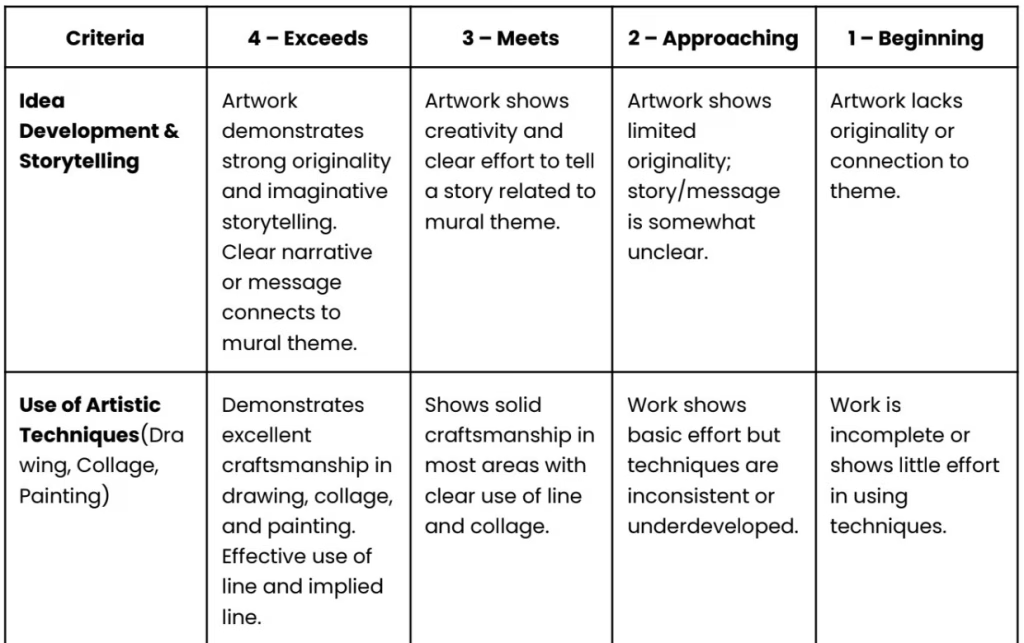
- Final Collaborative Mural evaluated with rubric criteria:
- Idea Development: originality and storytelling.
- Collaboration: effective teamwork, respect for peers’ contributions.
- Technique: craftsmanship in drawing, collage, and painting.
- Presentation: clarity in arranging pieces to support a collective theme.
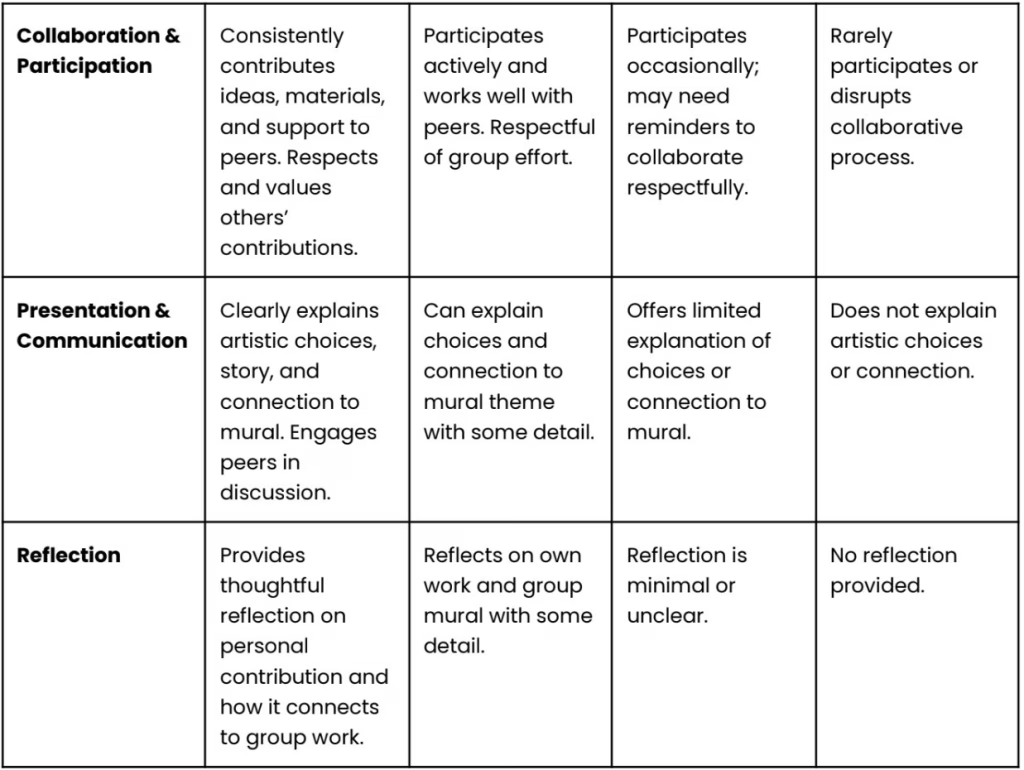
- Student Reflection Statement: Written or oral explanation of their
individual contribution and how it connects to the group’s mural.
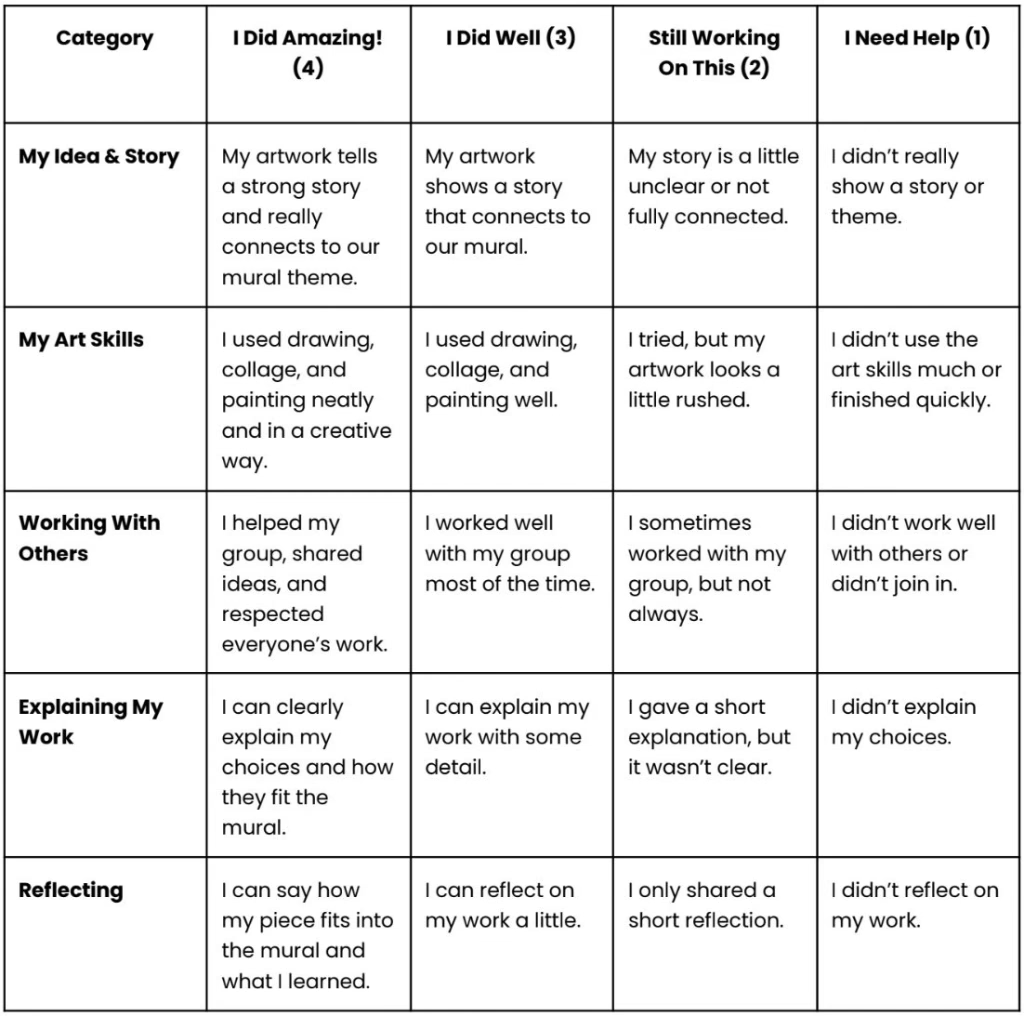
Student Self-Assessment Rubric (Simplified)
Resources
Possible themes – history, people, places, mental health, nature, environment, travel, community, animals/habitats
Possible art/artists to look at that show storytelling and implied line:
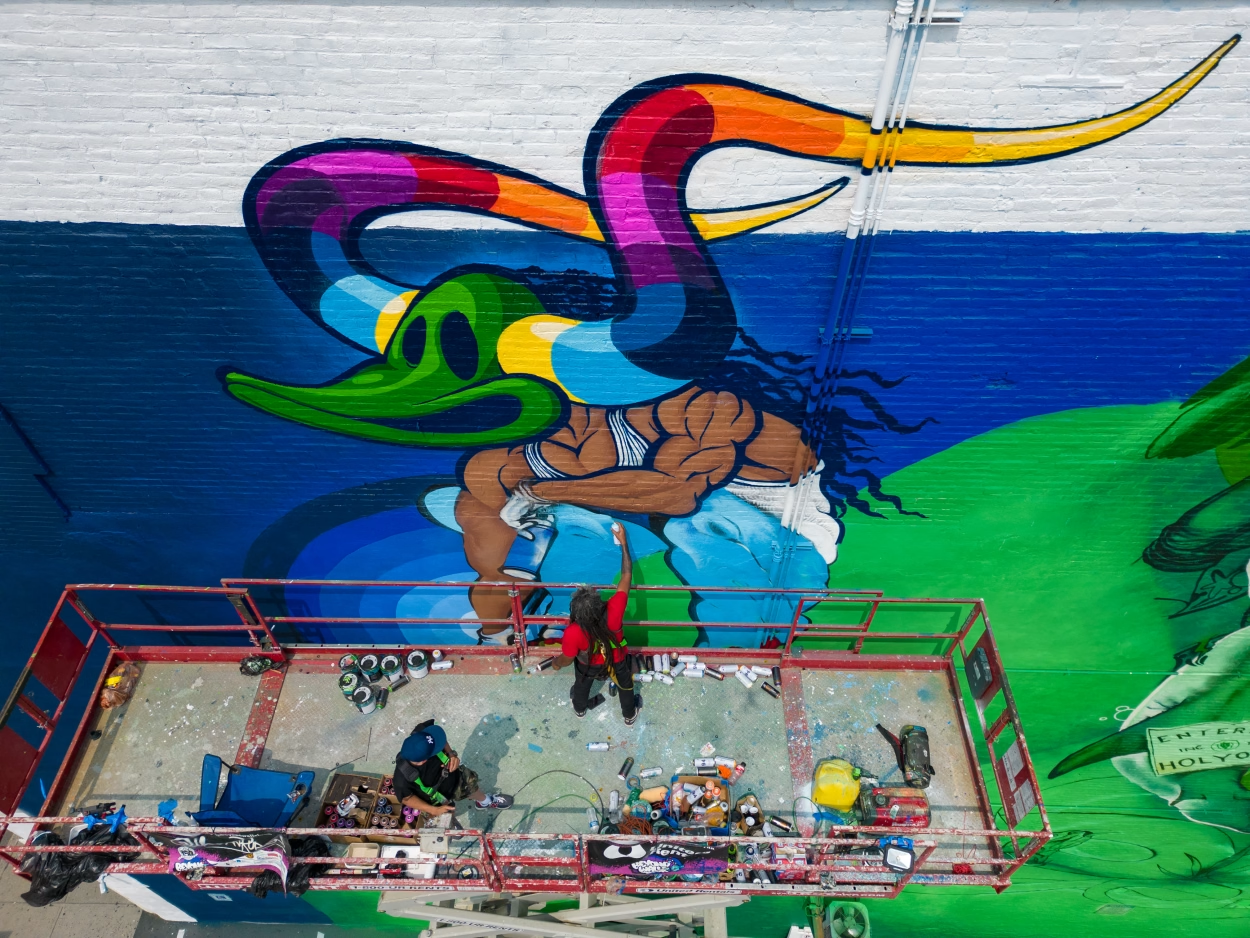
- Mr. B Baby
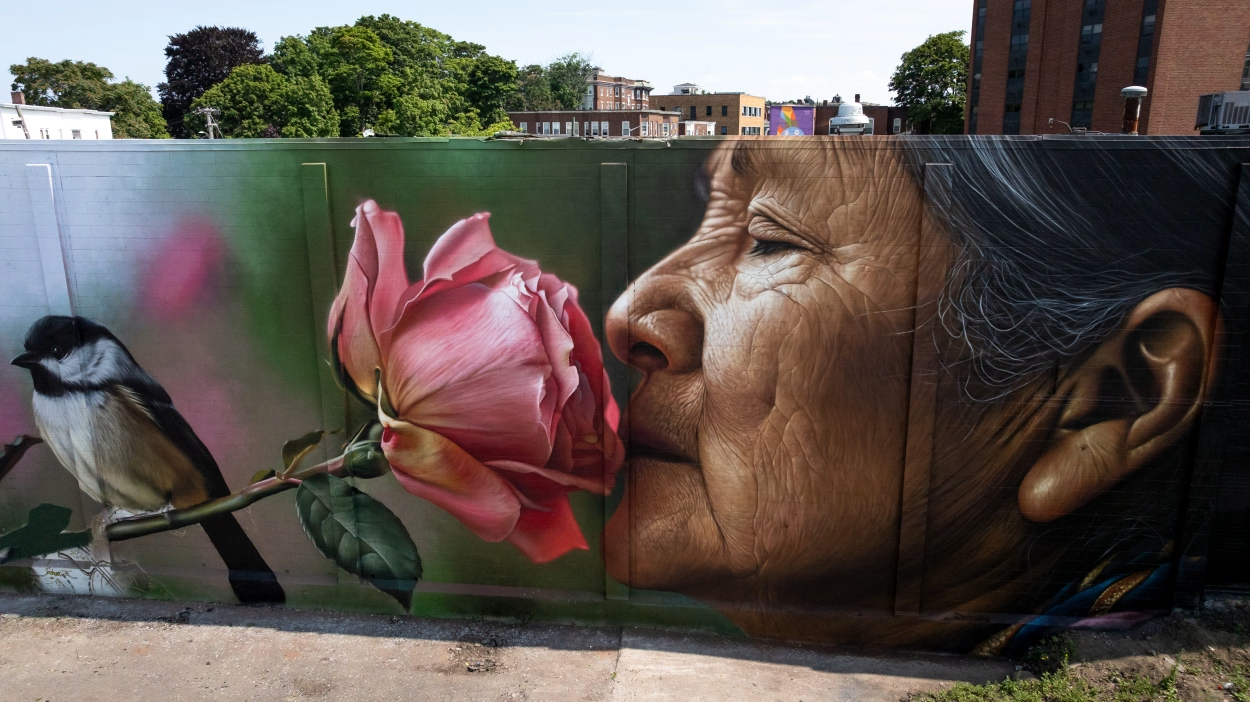
- Speker, Beyond Walls Mural
- Maurice Sendak, Where the Wild Things Are
- Tracy Lee Mcguinness-Kelly
- Eric Carle (collage)
- Henri Matisse (collage)
- Vincent van Gogh, The Starry Night
- William Turnbull, Marching Figures
- Eva Hesse, Untitled
- Julian Trevelyan, Ombla
- Ali Banisadr, Return to Mother
- William Blake, Oberon, Titania and Puck with Fairies Dancing
- Bernard Cohen, Matter of Identity III – The Trace
- Pieter Bruegel the Elder, The Fall of the Rebel Angels or The Wedding Dancer
- Hieronymus Bosch, Garden of Earthly Delights
- Jean-Baptise Greuze, A Father Curses his Ungrateful Son
- David Vinckboons, Landscape with a Hare Hunt
Example murals:
Tracy McGuinness-Kelly, Children’s Community Mural, 2017, Collage, AccessArt, https://www.accessart.org.uk/childrens-community-project/
Vicki Ostersen, Animal Habitats Mural, 2019, Collage, AccessArt, https://www.accessart.org.uk/animal-habitats-an-ecological-mural-of-planet-earth/.