
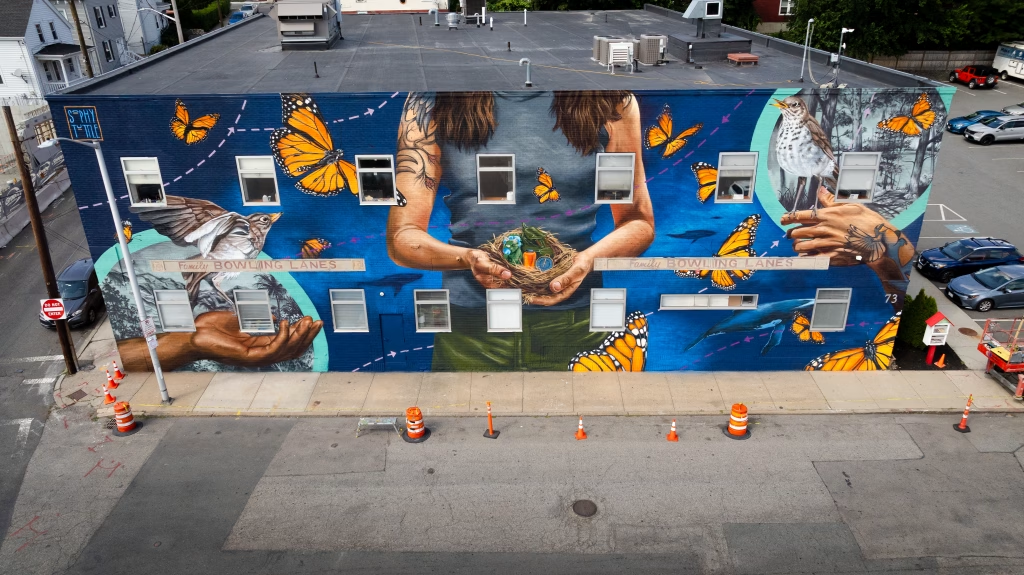
Six through Twelve.
Can be used in multiple classes for multiple mural examples. Each class is one to two hours.
Analysis and creation of art relating to the natural world and its power.
How organisms use migration (immigration and emigration) to ensure evolutionary fitness.
2016 Science and Technology Engineering Framework
How can there be power in migration?
What do you see in the mural that supports this idea?
What is going on in the mural that inspires you or makes you think…
What would you name this mural?
What would you write as an artist’s statement about what inspired this mural?
Where does our power lie in challenging times? And how do we bring back the whimsy in our art/lives?)
*Students will be able to:
1- design a surrealist eco-mural that argues how biodiversity promotes resistance to environmental change by illustrating overlapping, interdependent niches within a single local biome.
Art Project Integration: Students paint a food web where organisms visually blend into one another. If one species is “damaged” or erased, the rest of the mural’s visual network structurally maintains its form, demonstrating resilience. [1, 2]
*Students will be able to:
2-construct a 3D upcycled relief sculpture that communicates the direct impacts of pollution on the Lynn coastline by repurposing non-biodegradable consumer waste into an animal form.
Art Project Integration: Students collect clean plastic caps, bottles, and cardboard. They build a textured, high-relief animal mural panel (e.g., a local marine bird or fish), painting half of it realistically and leaving the other half raw to reveal the plastic waste underneath.
*Students will be able to… “SWRL-” (speaking, writing, reading, listening)
1-verbally defend how the mural’s visual elements represent ecological resilience by using complex conditional sentences and the target vocabulary words: biodiversity, resistance, niche, and interdependence.
*Students will be able to:
2-write an artist statement/placard that exposes how specific pollutants harm local coastal populations by using sequential transition words to describe the process of environmental degradation.
Migration Immigration
Emigration Habitats
Ecosystems. Reproductive Fitness
Core Resources Development
Habitat fragmentation Point Source Pollution
Global and Local Climate Changes Phonological Mismatch
Herbivores. Predator/Prey
To evaluate students’ ability to connect ecological concepts with intentional artistic choices, develop and revise an art plan, use materials purposefully, and communicate the meaning of their work.
| Criteria | 4 – Exceeds | 3 – Meets | 2 – Approaching | 1 – Beginning |
| Ecological Understanding | Accurately and insightfully communicates the selected ecological concept; relationships are specific, clear, and supported by evidence. | Clearly communicates the selected ecological concept with accurate relationships and appropriate details. | Ecological idea is partly clear; some relationships or details are incomplete or need clarification. | Ecological concept is unclear, inaccurate, or missing. |
| Visual Communication & Composition | Imagery, scale, color, texture, and composition work together in a highly intentional and creative way to reinforce the ecological message. | Visual choices clearly support the message; composition is organized and purposeful. | Some visual choices support the message, but composition or intent is inconsistent. | Visual choices do not clearly support the message; composition is incomplete or difficult to understand. |
| Materials, Technique & Craftsmanship | Materials are used skillfully and inventively; construction or painting is careful, refined, and highly intentional. | Materials and techniques are used effectively; work is complete and mostly careful. | Technique or craftsmanship is inconsistent; some areas are unfinished or need refinement. | Minimal control of materials or technique; work is incomplete, rushed, or lacks care. |
| Process, Revision & Problem-Solving | Shows strong planning, experimentation, persistence, and thoughtful revision in response to challenges and feedback. | Uses planning and feedback to solve problems and make appropriate revisions. | Shows some planning or revision but relies heavily on teacher support to solve problems. | Shows little evidence of planning, revision, persistence, or problem-solving. |
| Reflection & Presentation | Artist statement and presentation clearly explain the ecological message, artistic choices, process, and connection to Sophy Tuttle using precise vocabulary and thoughtful responses. | Explains the message, choices, and process using appropriate vocabulary and responds to questions clearly. | Reflection or presentation is brief, vague, or only partly explains the message and process. | Reflection or presentation is missing, incomplete, or unclear. |
Tier 1 instructional supports/MTSS:
SEI strategies:
SEL strategies:
IEP/504 accommodations:
“Sophy Tuttle is an English-born American muralist, painter, and installation artist. Her work celebrates and promotes culture-building between humans and all other forms of life. Often vibrant and dynamic, these murals are a way to begin conversations within the community about our relationship with nature and the ways in which we both conflict and collaborate with our fellow creatures every day. Sophy began painting murals while living in Oaxaca, Mexico in 2013, where she learned from local activists and artists. Her work can now be seen from Massachusetts to Colombia and she has participated in many mural festivals both nationally and internationally including Pangeaseed’s Sea Walls Festival (2020 & 2021, USA), Sunny Dayz Mural Festival (2024, USA) and the Cheltenham Paint Festival (2023, England).
Statement from the Artist: My work transforms sterile scientific facts into a rich visual landscape that can be easily accessed intellectually and emotionally by a wide range of people. In particular, I am drawn to mural work because of the inherently democratic viewership. To experience a public mural, the viewer does not need money, education, status, or access to spaces of privilege such as galleries or museums. When a mural is painted in a public space, through content, form, and sheer size, it has the enormous power to transform that space into a “place.” It can provide the seed for a more active, vibrant, collaborative, and discursive arena, and even set the intention of the actions that occur in that space through its collaborative creation and subject matter.
My work is focused on the natural world, our place in it, and the conflicts and collaborations we find ourselves in everyday with nature. My bright, carefully researched murals often aim to disrupt deeply embedded beliefs about Aristotle’s hierarchy of nature. I render birds, animals, and plants to evoke a sense of awe and reverence for these beings. Although extinction and loss loom in the man-made Anthropocene era, I hope that my paintings call attention to the magnificent beauty that still exists in nature today. (https://beyondwalls.org/artists/sophy-tuttle/)”
Please reflect on the lesson and give feedback when possible.
Braziel, J. E. (2024). Caribbean and Latinx street art in Miami. Taylor & Francis.
Daichendt, G. J. (2010). Artist teacher. https://doi.org/10.2307/j.ctv36xw1vs
Daichendt, G. J. (2019). Editorial. Visual Inquiry, 8(2), 101-102.
https://doi.org/10.1386/vi_8.2.101_2
(2026). Google Search. https://beyondwalls.org
Manco, T., Neelon, C., & Art, L. (2005). Graffiti Brasil.
Neelon, C. (2008). Caleb Neelon’s book of awesome.
Wiggins, G. P., & McTighe, J. (2005). Understanding by design. ASCD.
PROTOTYPE OF MURAL:
https://www.instagram.com/sophytuttle
https://www.facebook.com/SophyTuttleArt/
Lesson Plans Notes/Brainstorm:
What are the 3 things you will bring with you? Why those 3 things?
(Journaling)
Less heavy version: You are a senior in high school and you are preparing to leave for college. What are the 3 things from your room at home that you must bring with you to your dorm room in college? Why?
Deliverable: Create a work of art that shows the 3 things and conveys to the spectator why these 3 things are so important to you.
-One group of students studies migration patterns on different species of fish, birds, etc. between Venezuela (just an example) and Lynn.
-Another group studies migration patterns of human beings emigrating from Venezuela (just an example). What is the experience like crossing from Venezuela into Colombia, then crossing the Darien Gap between Colombia and Panama? And from there to the U.S. border, and eventually Lynn?
-Students in both groups will then compare migration patterns to see where they overlap.
-Why do human beings and animals emigrate from their homes in the first place? What is the experience of animals species and immigrants upon arriving in Lynn?
Learning goals and outcomes: To better understand where animal species and immigrations in Lynn come from, their journeys, and what they experience when they arrive in Lynn. Also, to better understand the difference between emigration, migration, and immigration.