ENVIRONMENTAL CONSCIOUSNESS WITH ART INSPIRED BY URBAN RUBEN

Inspired by Urban Ruben, In Partnership with Lynn Public Schools

ENVIRONMENTAL CONSCIOUSNESS WITH ART

KEY INDICATORS:

Create – Conceiving and developing new artistic ideas and work.
Respond – Understanding and evaluating how the arts convey meaning.
Present – Interpreting and sharing artistic work.
Connect – Relating artistic ideas and work with personal meaning and external context.

LEARNING OBJECTIVES:

Students will be able to…

  • Learn how we can be environmentally consciencious with our art.

STANDARDS ADDRESSED:

  • F.V.Cr.01. – Generate and conceptualize artistic ideas and work. Create artistic ideas that reflect characteristics of different artistic movements from different cultures (e.g., study art by different individual 20th century Australian aboriginal artists and choose one as an inspiration for a composition.
  • F.V.P.06. – Convey meaning through the presentation of artistic work. Describe how decisions about how an artwork is presented are connected to what the student wants to express, evoke, or communicate.
  • P.V.P.06. – Convey meaning through the presentation of artistic work. Modify a two- or three-dimensional installation to align to one’s artistic intent after listening to initial viewer comments.
  • P.V.Co.11. – Relate artistic ideas and works to societal, cultural and historical contexts to deepen understanding. Explain the relationship between artworks and commercialization or propaganda (How Norman Rockwell’s work, such as “Rosie the Riveter,” supported the war effort in World War II).

SUBJECT MATTER:

Create something from recycled / discarded materials

MATERIALS:

  • Anything!

VOCABULARY:

  • Reduce, Reuse, Recycle.
  • Construct
  • Repurpose

PROCEDURES:

Day 1 – Introduction & Collection of Materials

  • Introduction (10 min):
    • Teacher introduces the concept of Reduce, Reuse, Recycle in the context of art.
    • Show examples of recycled-material artworks (Golden’s “StayGolden” mural, Bordalo II animal sculptures).
  • Activity (30–35 min):
    • Students brainstorm items they could collect that might be repurposed.
    • Begin collecting 10 pieces of trash/discarded materials (in or outside the classroom).
    • Quick sketches or notes on possible uses for each item.
  • Wrap-Up (5 min):
    • Exit ticket: Write one way an artist can reduce waste through their process.

Day 2 – Artist Research & Idea Brainstorm

  • Warm-Up (5–10 min): Review “eco-artists” (Golden, Bordalo II, others).
  • Research Activity (20–25 min):
    • Students research artists who use discarded materials.
    • Document: artist’s name, one image of their work, and 2–3 sentences on how it inspires new uses for trash.
  • Mind Mapping (15–20 min):
    • Using their collected materials, students create a mind map of possible project directions.
    • Brainstorm how the theme of environmental responsibility can come through their work.
  • Wrap-Up (5 min): Share one research finding with a partner.

Day 3 – Sketch Development

  • Introduction (5–7 min):
    • Teacher demonstrates how to move from brainstorming → sketches → composition planning.
  • Activity (30–35 min):
    • Students create at least 3 sketches of intended designs using their materials.
    • Encourage experimenting with scale, arrangement, layering, and symbolic meaning.
  • Peer Share (10 min): Small groups exchange sketches, give feedback
    on clarity and environmental message.
  • Wrap-Up (5 min): Reflection in sketchbook: Which sketch feels most
    promising and why?

Day 4–6 – Construction / Building Phase

  • Day 4 (Plan & Begin Building):
    • Students finalize design and begin construction using their recycled materials.
    • Teacher checks that materials are safe, workable, and align to the project theme.
  • Day 5 (Continue Building):
    • Students refine construction, experiment with adhesives/fasteners, and adjust design.
    • Teacher circulates for one-on-one support and troubleshooting.
  • Day 6 (Finishing Touches):
    • Students paint, enhance, or refine details.
    • Emphasis on craftsmanship and thoughtful repurposing.

Day 7 – Presentation & Critique

  • Setup (10 min): Display all finished works around the classroom.
  • Gallery Walk (20 min):
    • Students circulate and leave sticky-note feedback (one strength + one suggestion).
  • Whole-Class Critique (15 min):
    • Students present their piece, explaining:
      • Materials used and why.
      • Message they wanted to communicate.
      • How their project reflects environmental consciousness.
  • Wrap-Up (5 min): Reflection prompt: What did you learn about making art sustainably?

Teacher Notes

  • This plan can flex depending on student pace — students who finish early can create a second small piece or experiment with painting techniques like mixing leftover acrylics (as in Golden’s mural).
  • Sketchbook rubric, effort rubric, and project rubric (teacher-provided) can be applied throughout.

DIFFERENTIATION STRATEGIES:

  • Small group instruction and feedback.
  • Student-friendly materials.
  • Work with a partner.

ASSESSMENT:

Formative Assessments (Checkpoints Along the Way)

  1. Day 1 – Exit Ticket (Brainstorming)
    • Prompt: List one way an artist can reduce waste in their artmaking process.
    • Assesses understanding of environmental artmaking practices.
  2. Day 2 – Artist Research Notes
    • Students record:
      • Artist’s name.
      • One image/example of work.
      • 2–3 sentences connecting the artist’s approach to their own project ideas.
    • Assesses connection between professional eco-artists and student brainstorming.
  3. Day 3 – Sketchbook Check
    • Students submit at least 3 design sketches with clear notes on how recycled materials will be used.
    • Teacher assesses experimentation, clarity, and alignment with environmental themes.
  4. Day 4–6 – Teacher Observation Logs
    • Informal observations during building:
      • Safe and effective use of materials.
      • Evidence of problem-solving.
      • Effort and engagement.
    • Teacher gives quick verbal or written feedback.

Summative Assessments (Final Evaluation)

1. Final Recycled Material Artwork

Evaluated with a Project Rubric (4-Point Scale):
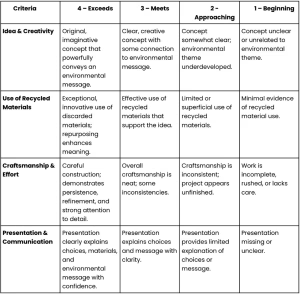
A rubric table with four evaluation criteria: Idea & Creativity, Use of Recycled Materials, Craftsmanship & Effort, and Presentation & Communication. Each is rated from Exceeds to Beginning with detailed descriptions in each cell.


2. Artist Reflection Statement (Written or Oral)

Prompts:

  • What was your central environmental message?
  • How did your choice of materials reinforce that message?
  • What challenges did you face during construction, and how did you solve them?
  • How did studying Golden, Bordalo II, or other eco-artists inspire your project?

Assessed on: clarity, depth of explanation, and ability to connect process to
environmental consciousness.

RESOURCES:

  • Golden’s mural
  • Bordalo II mural

NOTES:

For Golden’s “STAYGOLDEN” mural, we went to the basement and mixed leftover acrylic paints. We created new/bright colors and didn’t waste materials. It was probably worth about $ 1,000 in paint.

Skip to content