COLLABORATIVE MURAL: PROMOTING SAFETY, CULTURAL UNDERSTANDING, AND EMOTION REGULATION INSPIRED by BUBLEGUM

Inspired by Bublegum, In partnership with Lynn Public Schools

COLLABORATIVE MURAL: PROMOTING SAFETY, CULTURAL UNDERSTANDING, AND EMOTION REGULATION

KEY INDICATORS:

Create – Conceiving and developing new artistic ideas and work.
Present – Interpreting and sharing artistic work.

LEARNING OBJECTIVES:

Students will be able to…

  • Create a collaborative mural that conveys safety, cultural understanding, and emotional regulation.
  • Work with others to create a collaborative mural.
  • Identify and share ideas about safety in our community and during building activities.
  • Recognize and respect cultural differences through art and discussion.
  • Express my feelings and how to manage emotions through creating art.
  • Contribute to designing and painting a mural that promotes safety, cultural understanding, and emotional expression.

STANDARDS ADDRESSED:

  • Generate and conceptualize artistic ideas and work. Create artistic ideas that reflect characteristics of different artistic movements from different cultures. (F.V.Cr.01)
  • Organize and develop artistic ideas and work. Develop multiple plans for producing a piece of artwork prior to selecting one. (F.V.Cr.02). 3.
  • Select, analyze, and interpret artistic work for presentation. Justify choices for curating and presenting artwork for a specific exhibit or event. (F.V.P.04)

SUBJECT MATTER:

Elementary: Drawing, color theory (safe/powerful), Painting.
High School: Drawing, Collage, 3D, Painting, Mixed Media

MATERIALS:

  • Large mural paper or exterior/interior wall space (if available)
  • Paints, brushes, markers
  • Sketching paper and pencils
  • Visual resources on safety, cultural symbols, and emotions
  • Reflection journals or worksheets

VOCABULARY:

Mural – A large artwork painted or created directly on a wall or surface, often made for public viewing.
Symbol – A picture, object, or design that represents a bigger idea, value, or feeling.
Community – A group of people who share a place, culture, or common goals.
Culture – The beliefs, traditions, art, and practices shared by a group of people.
Cultural Understanding – Recognizing, respecting, and valuing differences and similarities among people’s traditions, beliefs, and art.
Emotion Regulation – The ability to recognize, express, and manage one’s feelings in healthy ways.
Safety – Actions, rules, and practices that keep people protected while creating or participating in community activities.
Collaboration – Working together with others to achieve a common goal.
Design – The plan or arrangement of shapes, colors, and symbols in an artwork.
Expression – The way an artist shares feelings, ideas, or beliefs through art.
Respect – Showing consideration for others’ feelings, cultures, and contributions in both artmaking and collaboration.
Public Art – Art displayed in places where everyone in the community can see it and be influenced by it.

PROCEDURES:

All days are based on a 45-60 minute class period.

Day 1 – Introduction

  • Discuss the purpose of murals as public art and symbols of community values.
  • Talk about safety, cultural differences, and emotion regulation as themes.
  • Show examples of Bubblegum’s work and support students in a discussion how his mural promotes cultural understanding and safety.

Day 2 – Brainstorming & Concept Development

  • In small groups, students brainstorm ideas related to:
    • Safety in building and community spaces
    • Cultural symbols and respectful representations
    • Ways to express and regulate emotions through art
    • Each group creates a rough sketch of their mural section.

Day 3-7 – Planning & Design

  • Groups develop detailed designs, incorporating safety messages, cultural symbols, and emotional expressions
  • Facilitate discussions on cultural sensitivity and emotional symbolism
  • Gather feedback from the class and refine designs
  • Creation of Mural (Multiple sessions)
  • Collaboratively paint or assemble the mural based on the finalized designs
  • Emphasize teamwork, safety protocols during art creation, and respectful cooperation.

Day 8 – Reflection & Discussion

  • Once complete, hold a class discussion on:
    • What they learned about safety, cultural differences, and emotions
    • How collaboration influenced the final artwork
    • Personal feelings and emotional regulation during the project
  • Students can write in journals about their experiences

DIFFERENTIATION STRATEGIES:

  • Tier 1 Whole and Small Group Instruction
  • Tier 2 Small Group Reteach/Support
  • Guided Practice
  • Students with IEPs/504s – provided step-by-step practice, and extra time as needed, see IEP for more specific accommodations. Subject to change based on students’ needs.

ASSESSMENT:

  • Observation of participation and collaboration
  • Reflection journals or sheets
  • Final mural as a visual demonstration of understanding

Purpose:
To assess students’ ability to:

  • Design and contribute to a collaborative mural that communicates themes of safety, cultural understanding, and emotional regulation.
  • Apply artistic processes (brainstorming, sketching, refining, and painting).
  • Demonstrate collaboration, reflection, and cultural sensitivity throughout the mural project.

Formative Assessments

  • Day 1 Exit Ticket: Students list one way murals can promote safety, one cultural symbol they know, and one emotion they can express in art.
  • Day 2 Group Sketches: Each group submits rough drafts showing their initial ideas for safety, culture, and emotions.
  • Ongoing Observations (Days 3–7): Teacher records student participation, safe practices, and cooperation during design and painting.
  • Peer Feedback Sessions: Students provide constructive feedback during class discussions and design reviews.

Summative Assessment

  • Final Collaborative Mural: Completed mural that integrates visual elements of safety, cultural understanding, and emotional regulation.
  • Reflection Journal / Artist Statement: Students reflect individually on:
    • What their group’s section represents.
    • How their personal contributions connected to the overall theme.
    • What they learned about safety, culture, and emotion regulation.
    • How working collaboratively influenced their perspective and final artwork.

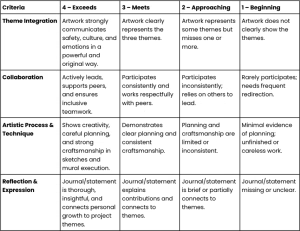
Rubric (4-Point Scale)

A rubric table with four criteria—Theme Integration, Collaboration, Artistic Process & Technique, and Reflection & Expression—each rated from 4 (Exceeds) to 1 (Beginning) based on detailed performance descriptions.


Tiered Supports for English Language Learners (ELLs)

Beginning ELLs

  • Visual word banks for “safety,” “culture,” “emotion,” with images.
  • Sentence starters: “My mural shows ___ because ___.
  • Option for oral or illustrated reflection instead of extended writing.

Intermediate ELLs

  • Graphic organizers for brainstorming and reflection.
  • Work with bilingual peers during planning and critique.
  • Encourage bilingual labeling of sketches before translating into English.

Advanced ELLs

  • Scaffolded critique language: “This design communicates ___ effectively because ___.
  • Challenge to research cultural art motifs and integrate them.
  • Opportunities to co-lead group presentations of the mural.

Teacher Notes

  • Emphasize process + product + reflection rather than only the finished mural.
  • Use frequent check-ins during design and painting to monitor collaboration and safety practices.
  • Provide both individual accountability (reflection, participation) and group accountability (final mural section).

RESOURCES:

Skip to content