11/12th Grade.
50-55 minutes, 1-2 classes
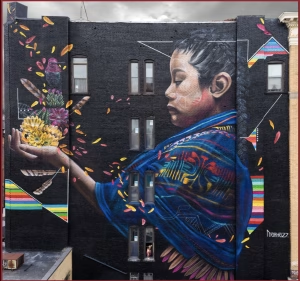
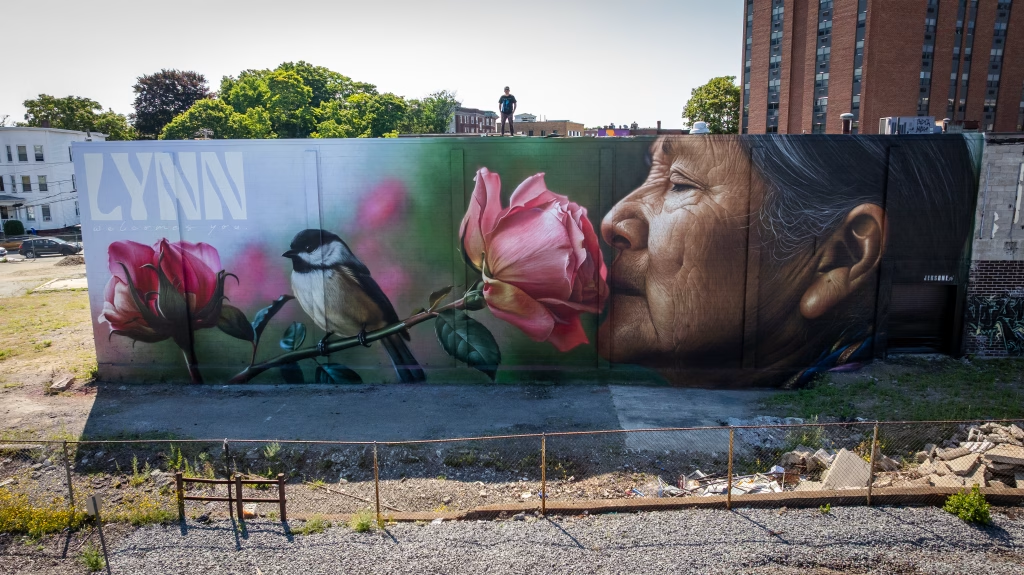
Students will learn about mural artists Marka27 and JEKS and understand the symbolism they use. They will also explore the intentions of the murals.
Perceive and analyze artistic work. Analyze the style of an artist, and how it manifests itself in a given artwork. (e.g., examine influences on the artist). (F.V.R.07)
Interpret intent and meaning in artistic work. Identify specific elements in a work that connect it to a specific genre or style. (F.V.R.08)
Synthesize and relate knowledge and personal experiences to make art. Describe what has influenced changes in one’s own artistic style and preferences in visual art. (F.V.Co.10)
Relate artistic ideas and works to societal, cultural and historical contexts to deepen understanding. Identify the connections between historical and cultural contexts and define stylistic elements of artistic movements (e.g., how the impact of World War II influenced the western art world and shifted focus from Europe to New York City). (F.V.Co.11)
Why do people make public, community-facing art? How do artists use symbolism to communicate ideas?
*Students will be able to: interpret and analyze murals by Marka27 and JEKS.
*Students will be able to: reflect on the murals and make connections to their personal experiences.
*Students will be able to: answer the do now and exit tickets through written responses.
*Students will be able to: verbally discuss the murals with their peers.
Do Now: Students answer the following questions on a piece of paper
Students view two murals on the board, with printed copies provided at their tables. Prompted by questions on the board, students discuss the art with their table groups:
Exit ticket:
Slideshow on smartboard
To evaluate students’ ability to observe and analyze public murals, interpret symbolism and artistic intent using visual evidence, compare works by JEKS and Marka27, participate in collaborative discussion, and connect public art to community and personal experience.
| Criteria | 4 – Exceeds | 3 – Meets | 2 – Approaching | 1 – Beginning |
| Observation & Visual Evidence | Identifies specific, nuanced visual details and consistently uses them as evidence to support ideas about the murals. | Identifies relevant visual details and uses evidence to support interpretations. | Notices some details, but evidence is general, incomplete, or only loosely connected to interpretations. | Provides minimal observation or does not use visual evidence. |
| Symbolism & Artistic Intent | Offers thoughtful, well-supported interpretations of symbolism, imagery, and purpose in both murals. | Clearly interprets major symbols, imagery, and artistic purpose with reasonable support. | Interpretation is partly developed or overly general; symbolism or purpose needs clarification. | Interpretation is missing, inaccurate, or unsupported. |
| Compare, Contrast & Context | Makes insightful comparisons between the murals and clearly connects similarities and differences to style, message, or community context. | Identifies meaningful similarities and differences and connects them to the artworks’ purposes. | Identifies basic similarities or differences but provides limited explanation. | Provides little or no comparison between the works. |
| Discussion & Academic Language | Consistently contributes thoughtful ideas, listens respectfully, builds on peers’ comments, and uses visual-arts vocabulary precisely. | Participates appropriately, listens to peers, and uses relevant vocabulary during discussion. | Participation is limited or vocabulary use is inconsistent. | Rarely participates, is off-task, or does not use appropriate discussion language. |
| Reflection & Community Connection | Exit ticket makes a thoughtful, specific connection between public art, community impact, and personally meaningful symbols. | Exit ticket clearly explains a community impact and identifies relevant personal/community symbols. | Reflection is brief, vague, or only partly connects public art to community or personal experience. | Reflection is missing, incomplete, or does not address the prompts. |
Student differentiation:
“JEKS is a renowned graffiti artist and muralist based in Greensboro, North Carolina, whose vibrant and dynamic works adorn building facades and public spaces in cities across the world. He has made a name for himself globally with his hyper-realistic monochromatic portraits as well as full-color portraits that feature meticulous detail, symmetry, smooth gradients, saturation, and emotion. His artwork stands out for its unique blend of realism and surrealism.
JEKS has dedicated himself to mastering the aerosol medium and has developed a self-taught mastery that few artists possess. His devotion to his craft is evident in the quality and depth of his work. His pieces are highly sought after by collectors and art enthusiasts alike, and he has participated in numerous exhibitions and public art projects.
Through his art, JEKS seeks to inspire and uplift people, using his skills to create beautiful and thought-provoking works that capture the essence of the human experience. His contribution to the world of street art and graffiti is significant, and his impact is felt by all those who have had the pleasure of experiencing his work.” (https://www.instagram.com/p/DaAuk8xOeHo/?utm_source=ig_web_copy_link&igsh=MzRlODBiNWFlZA==)
Please reflect on the lesson and give feedback when possible.
Braziel, J. E. (2024). Caribbean and Latinx street art in Miami. Taylor & Francis.
Daichendt, G. J. (2010). Artist teacher. https://doi.org/10.2307/j.ctv36xw1vs
Daichendt, G. J. (2019). Editorial. Visual Inquiry, 8(2), 101-102.
https://doi.org/10.1386/vi_8.2.101_2
(2026). Google Search. https://beyondwalls.org
Manco, T., Neelon, C., & Art, L. (2005). Graffiti Brasil.
Neelon, C. (2008). Caleb Neelon’s book of awesome.
Wiggins, G. P., & McTighe, J. (2005). Understanding by design. ASCD.
JEKS reference photo:

Marka27 Mural: